
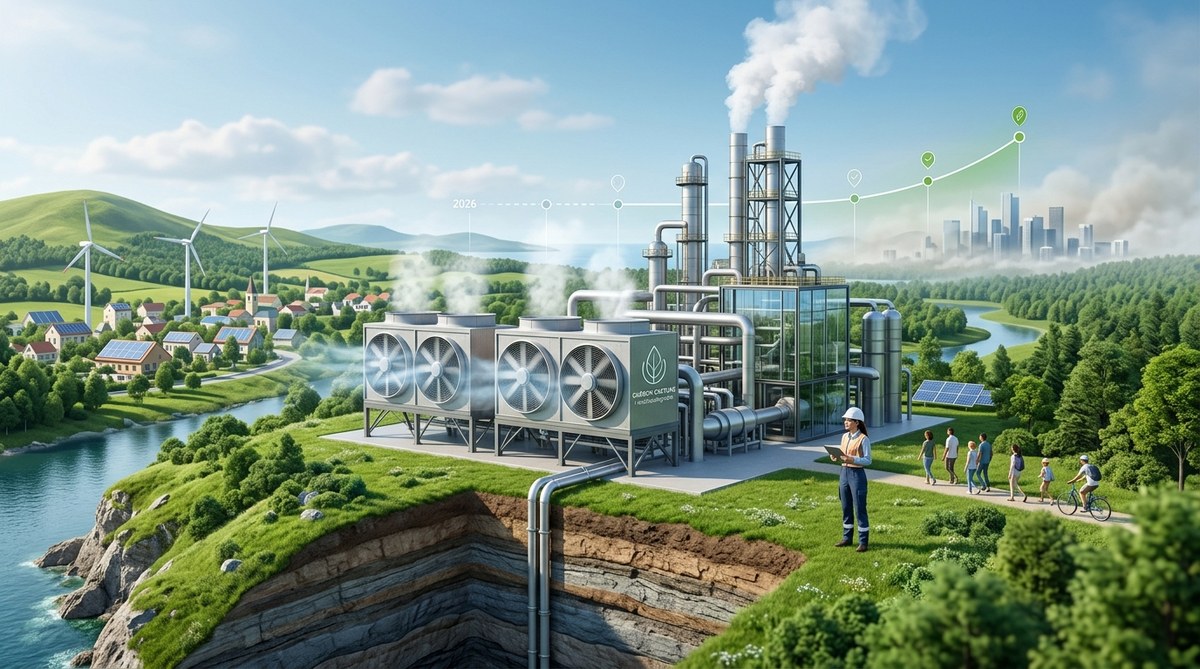
You have probably seen headlines that claim carbon capture technology could suck billions of tons of CO2 out of the sky and save the planet. It sounds like a sci fi solution. A giant vacuum for the atmosphere. The idea is seductive. If we can just build enough machines, we can keep burning fossil fuels and fix the mess later. But does the math actually work? Can carbon capture reverse climate change in any meaningful way by 2026? Let’s look at the facts without the hype.
Carbon capture is a genuine tool, but it is not a silver bullet. By 2026 the world will have removed only a tiny fraction of annual emissions using these technologies. Reversing climate change requires radical cuts in emissions first, and carbon capture can only help clean up the hardest to avoid leftovers. Relying on it as a primary solution is dangerously optimistic.
What is carbon capture and how does it work?
Carbon capture technology grabs CO2 before it reaches the atmosphere, or pulls it directly out of air that is already there. There are two main families of this technology.
Point source capture is installed at industrial sites like power plants, cement factories, and steel mills. It captures CO2 from exhaust streams before they leave the smokestack. The captured gas can then be compressed and transported for storage underground or for use in products like synthetic fuels.
Direct air capture (DAC) is the more futuristic sibling. Giant fans pull ambient air over chemical filters that bind CO2. When the filter is heated, it releases a concentrated stream of carbon dioxide that can be stored or used.
Both approaches have been around for decades in small scale projects. But scaling them to reverse climate change is a completely different challenge.
“Direct air capture is like trying to bail out a bathtub with a teaspoon while the faucet is still running. We need to turn off the faucet first.” — Dr. Jennifer Wilcox, former Principal Deputy Assistant Secretary for the Office of Fossil Energy and Carbon Management
The reality of reversing climate change with carbon capture
Reversing climate change means not just slowing the increase of CO2 but actually reducing its concentration in the atmosphere. That requires removing far more carbon than we emit. Global CO2 emissions in 2025 were roughly 37 billion tons. In 2026 we are on track for a similar number. Current carbon capture projects remove around 50 million tons per year. That is about 0.13% of annual emissions.
To make a real dent, we would need thousands of large scale facilities. Even the most ambitious projections show DAC removing maybe 0.1 gigatons by 2030. The gap is enormous.
Here are the practical steps that would need to happen for carbon capture to help reverse climate change:
-
Deploy at massive scale. Build thousands of direct air capture plants and equip every major industrial source with capture technology. This would cost trillions of dollars and take decades.
-
Solve storage permanence. Pumping CO2 underground is not enough. We need to ensure it stays there for centuries. Leakage from storage sites could undo all the progress.
-
Slash the energy cost. Carbon capture uses a lot of energy. If that energy comes from fossil fuels, the net benefit shrinks. It must be powered by renewables or nuclear.
-
Bring costs down dramatically. Current DAC costs range from $400 to $800 per ton of CO2. To be viable at scale, costs must fall below $100 per ton. Some startups are working on it, but we are not there yet.
-
Build the infrastructure. We need pipelines and injection wells, plus monitoring networks. Permitting alone can take a decade in the United States.
Comparing carbon capture techniques
| Method | Where it works | Current scale (million tons/yr) | Cost per ton (range) | Maturity level |
|---|---|---|---|---|
| Point source | Power plants, industry | ~40 | $30 – $70 | Proven, commercial |
| Direct air capture | Anywhere with low humidity | ~0.01 (tiny) | $400 – $800 | Early stage |
| Bioenergy with capture (BECCS) | Biomass power plants | ~2 | $50 – $150 | Demonstration |
| Enhanced weathering | Mines, farmland | ~0.001 (experimental) | $50 – $200 | R&D |
| Reforestation | Land everywhere | ~2 (natural, not tech) | $5 – $50 | Mature, scalable |
The table shows that the most mature carbon capture technologies are still tiny relative to what is needed. Natural solutions like planting trees are cheaper and ready now, but they compete with farmland and cannot capture enough on their own.
Common misconceptions about carbon capture
-
Misconception: Carbon capture can replace emission cuts. In reality, cutting emissions is always cheaper and faster than capturing them afterward. Carbon capture is a supplement, not a substitute. We still need to shift to renewable energy, electrify transport, and improve efficiency.
-
Misconception: Carbon capture is the only way to deal with legacy CO2. The truth is that the best way to remove historic CO2 is to stop adding more. Without drastic reductions, carbon capture will always be playing catch up.
-
Misconception: By 2026 we will have deployed DAC at scale. Current projects like Climeworks’ Mammoth plant in Iceland can capture 4,000 tons per year. That is a rounding error. Even with planned expansions, total DAC capacity will remain below 0.01% of global emissions by 2026.
-
Misconception: Captured CO2 is always stored safely. Some captured carbon is used to enhance oil recovery, which actually produces more oil and leads to new emissions. Not all capture is created equal.
Can it happen by 2026?
The short answer is no, not at a scale that would reverse climate change. By 2026 total carbon capture capacity worldwide will likely be around 50 to 60 million tons per year. That is a tiny fraction of the 37 billion tons we emit each year. We are not on track to reverse anything.
But that does not mean carbon capture is useless. It plays an important role in decarbonizing industries like cement and steel, where emissions are hard to avoid. It can also help with the last few percent of emissions after we have done everything else. And the experience gained from projects today will bring costs down for the future.
We should not dismiss carbon capture entirely. But we must keep it in perspective. The real work of reversing climate change depends on cutting emissions, switching to renewables, and restoring natural carbon sinks like forests and wetlands. For more on how communities are leading the way, read how communities can lead the way in climate change adaptation by 2026. And if you want to understand the broader role of technology, see how innovative technologies are transforming climate change mitigation.
A balanced path forward
Carbon capture is a tool in the box, not the whole toolbox. The most effective way to reverse climate change is to stop burning fossil fuels in the first place. Every dollar spent on carbon capture should be weighed against the same dollar spent on solar panels, wind turbines, and efficiency upgrades.
For environmentally conscious individuals, the best action is still reducing your own carbon footprint and supporting policies that drive systemic change. Read about innovative strategies to reduce carbon footprints in urban areas for practical steps you can take today.
The year 2026 will not be the year carbon capture saves us. But it can be the year we get serious about every climate solution we have, including capture, while we work hardest on the ones that matter most. That is the honest, hopeful path forward.