
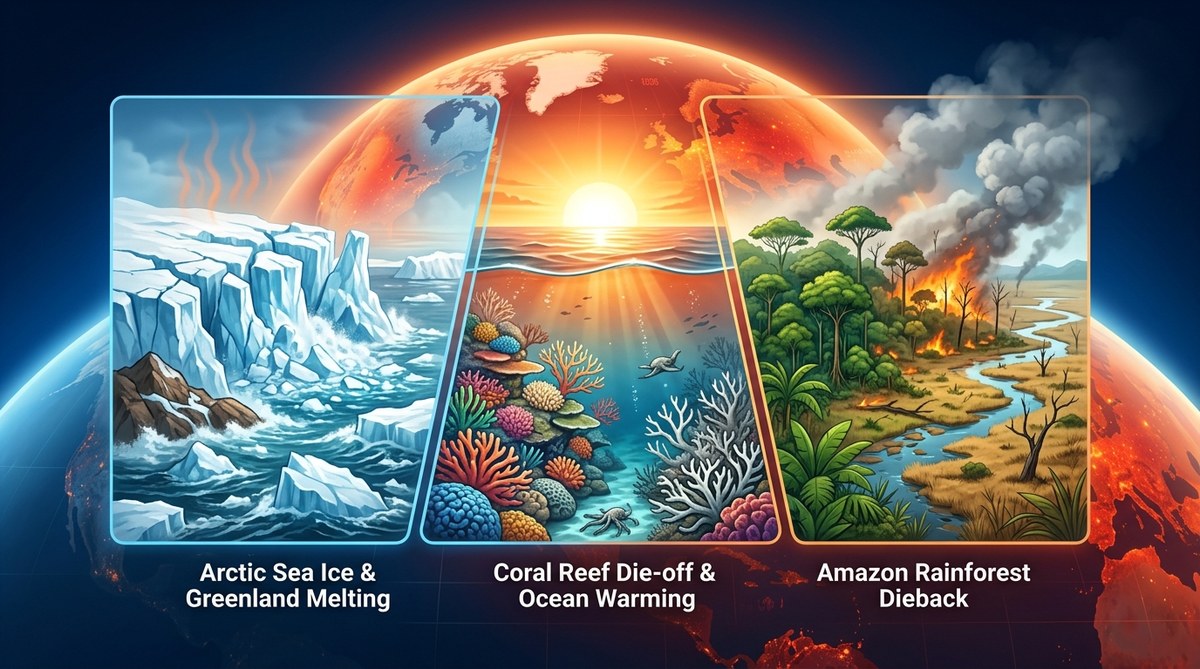
We are standing on the edge of a moment that scientists have warned about for decades. Climate tipping points are thresholds that, once crossed, trigger self-sustaining changes with consequences that are hard to reverse. In 2026, we are closer than ever to several of these critical boundaries. Some systems may already be showing early warning signals. If you care about the future of our planet, understanding these tipping points is the first step to staying informed and prepared. Let’s look at the three most imminent climate tipping points this year.
Climate tipping points are irreversible thresholds in Earth’s systems. In 2026, three are dangerously close: Greenland ice sheet collapse, Amazon rainforest dieback, and Atlantic Ocean current shutdown. Each could accelerate global warming, disrupt weather patterns, and damage ecosystems. Immediate action can still reduce risks. The choices we make over the next few years will determine whether we cross these points or pull back.
The Greenland Ice Sheet: A Slow Motion Collapse
The Greenland ice sheet holds enough frozen water to raise global sea levels by about 23 feet. For years scientists thought it would take centuries to melt completely. New data in 2026 suggests that parts of the ice sheet may have already passed a point of no return.
When ice melts on the surface, it forms streams that carve deeper into the ice. These streams can speed up the flow of ice toward the ocean. As the ice sheet loses mass, its surface drops lower into warmer air, which melts it even faster. This feedback loop is what makes it a tipping point.
Signs that Greenland is approaching a tipping point include:
– Record low surface mass balance for several consecutive years.
– Increased frequency of meltwater lakes on the ice surface.
– Accelerated glacier calving at marine outlets.
Three practical steps researchers use to monitor the ice sheet:
1. Satellite altimetry measures changes in ice elevation.
2. Gravity recovery satellites (like GRACE) detect mass loss.
3. Ground based GPS stations record ice flow velocity.
If the Greenland ice sheet completely destabilizes, sea level rise could accelerate beyond current projections. Coastal cities from Miami to New York would face more frequent flooding and higher storm surges. The https://localcooling.com/how-climate-change-is-redefining-disaster-preparedness-in-the-us/ adaptation plans that communities are building now must consider this risk.
“The melting of Greenland is not a cliff we fall off. It is a slide we can still slow down if we cut emissions today.” — Dr. Karen Alley, glaciologist.
Amazon Rainforest Dieback: The Jungle’s Last Stand
The Amazon is often called the lungs of the planet. But in 2026, it is breathing harder. Deforestation, drought, and rising temperatures are pushing the rainforest toward a tipping point where large areas could convert into dry savanna.
When a forest loses enough trees, it disrupts the water cycle that creates rainfall. Less rain means more trees die, which means even less rain. This vicious cycle can flip a lush rainforest into a grassy plain. Scientists estimate that 20 to 25 percent deforestation could trigger this shift. We are already above 17 percent.
How the Amazon tipping point affects the globe:
– The forest stores about 150 to 200 billion tons of carbon.
– Releasing that carbon would add years of global emissions.
– Loss of biodiversity would be catastrophic, with thousands of species at risk.
Common misconceptions about the Amazon dieback:
| Misconception | Reality |
|---|---|
| The Amazon is too big to change. | Even partial dieback can alter rainfall patterns across South America. |
| Trees regrow quickly after cutting. | Secondary forests store far less carbon and take decades to recover. |
| Only local farmers are to blame. | Global demand for beef, soy, and palm oil drives deforestation. |
The Amazon tipping point is not only about Brazil. It affects weather in the United States too. The moisture that flows from the Amazon helps drive rainfall in parts of the Midwest and the Gulf Coast. If the forest collapses, American farmers could see changes in growing seasons. That is why https://localcooling.com/how-climate-change-is-driving-up-your-grocery-bill-and-what-you-can-do-about-it/ matters right now.
In 2026, several policies are being debated in the US Congress to link trade agreements with forest protection. Consumers can also make a difference by choosing certified sustainable products and reducing food waste. https://localcooling.com/top-5-sustainable-practices-for-businesses-to-reduce-carbon-emissions/ offers a starting point for companies that want to help.
Atlantic Meridional Overturning Circulation (AMOC) Collapse
The AMOC is a massive system of ocean currents that moves warm water from the tropics toward the North Atlantic. It acts like a giant conveyor belt that regulates climate across the Northern Hemisphere. In 2026, new research shows that the AMOC is at its weakest point in over a thousand years.
If the AMOC shuts down, the consequences would be immediate and severe. Northern Europe would cool by several degrees, sea levels would rise along the US East Coast, and tropical rain belts would shift. This is not a scenario from a Hollywood movie. It is a real possibility.
Signs that the AMOC is nearing a tipping point:
– Freshwater from Greenland melt is diluting the surface ocean.
– Reduced salinity makes it harder for water to sink, weakening the current.
– Models show a slowing trend that could become abrupt.
Why this matters for Americans:
– Boston and New York could see sea level rise of an extra foot by 2050.
– Hurricane patterns could become more unpredictable.
– Winter storms might become more intense in the Northeast.
The AMOC tipping point is especially dangerous because it interacts with other systems. A weaker AMOC could accelerate Greenland ice loss, which in turn weakens the AMOC even more. That is why scientists call it a “cascade.” To understand how technology might help monitor these changes, look at
How to Stay Informed and Take Action
You do not need to be a scientist to make a difference. Being aware of these climate tipping points 2026 is the first step. The next step is reducing your own carbon footprint and supporting policies that protect our planet. There are practical things you can do today.
A checklist for action:
– Calculate your carbon footprint using a free online tool.
– Switch to a renewable energy provider if available in your area.
– Reduce food waste, especially meat and dairy.
– Vote for candidates who prioritize climate action.
– Support organizations that work on forest conservation and ocean protection.
For more inspiration on how communities are leading the way, read about Every city and neighborhood can adopt local solutions that add up to global change.
The Path Forward in 2026
These three climate tipping points are not abstract ideas. They are measurable, observable thresholds that we are approaching rapidly. The Greenland ice sheet, the Amazon rainforest, and the AMOC are each a test of our ability to act collectively.
The good news is that we still have time. Every ton of carbon we do not emit reduces the risk of crossing these boundaries. Every acre of forest we protect preserves a vital carbon sink. Every policy that accelerates renewable energy gets us closer to a stable climate.
In 2026, the world is watching. But more importantly, you can act. Start with one change today. Talk to your friends and family about why https://localcooling.com/why-2026-is-the-pivotal-year-for-climate-action-in-the-united-states/ is so critical. Together, we can tip the scales in favor of a livable future.