
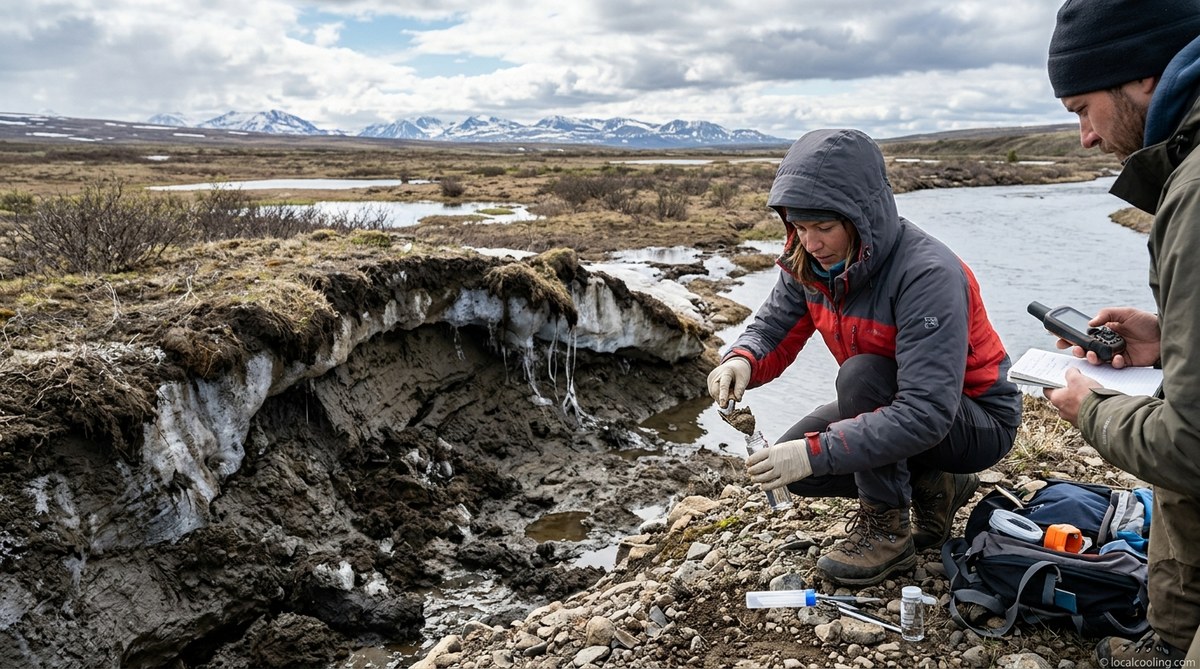
The ground beneath our feet is waking up. Across Alaska, Canada, and Siberia, permafrost that has stayed frozen for tens of thousands of years is starting to thaw. As global temperatures rise, this frozen soil is releasing more than just water and methane. It is releasing things that have been locked away since the last ice age. Scientists are now studying the real risk of melting permafrost ancient pathogens climate change creates, and what it might mean for public health across the United States and the world.
Thawing permafrost due to climate change is releasing dormant viruses and bacteria that could be thousands of years old. While the risk of a major outbreak remains low, scientists are closely monitoring these ancient pathogens. Understanding this process helps us prepare for potential health threats and reinforces the need to slow global warming.
What Is Permafrost and Why Is It Thawing?
Permafrost is ground that has remained at or below 32 degrees Fahrenheit for at least two consecutive years. Some of it has been frozen for more than 700,000 years. This frozen layer acts like a natural freezer, preserving organic material including dead plants, animal carcasses, and microbes.
The Arctic is warming about four times faster than the rest of the planet. As the air temperature rises, the permafrost thaws deeper and wider each summer. In 2026, scientists estimate that up to 40 percent of the world’s permafrost could be gone by the end of the century if emissions continue at current rates.
How Ancient Pathogens Get Released
When permafrost thaws, it does not just turn into mud. It collapses, shifts, and exposes layers that have been sealed off from the surface for millennia. Here is how ancient pathogens can re-enter the world:
- Thawing exposes buried remains. Animal carcasses infected with bacteria like anthrax can resurface after being frozen for centuries. In 2016, a anthrax outbreak in Siberia killed a child and thousands of reindeer after a heatwave thawed a decades-old carcass.
- Meltwater carries microbes into rivers and lakes. As ice turns to liquid, bacteria and viruses flow into waterways that communities rely on for drinking water and fishing.
- Human activity disturbs frozen ground. Mining, oil drilling, and road construction in Arctic regions dig into permafrost, directly exposing ancient soil layers to the air.
The Science Behind Zombie Viruses
Researchers have already revived several ancient viruses from permafrost samples. In 2014, a team in France brought back a 30,000-year-old virus from Siberian permafrost. It was still infectious. More recently, scientists found a 48,500-year-old virus that could still infect single-celled organisms in a lab.
These findings raise an unsettling question: could a virus that sickens humans survive being frozen for thousands of years and then infect someone today?
“We don’t know what is in the permafrost. We only know that it contains a huge diversity of microbes, some of which could be pathogenic. The risk is low, but it is not zero.” Dr. Jean-Michel Claverie, Emeritus Professor of Medicine at Aix-Marseille University
The biggest concern is not a single pandemic from one ancient virus. The real danger is that we might see local outbreaks of diseases we thought were gone, like smallpox or anthrax, in communities that have no immunity to them.
Common Misunderstandings About Ancient Pathogens
There is a lot of misinformation about this topic. Here is a table that separates fact from fiction.
| Common Misunderstanding | Scientific Reality |
|---|---|
| Ancient viruses will cause a global pandemic. | Most ancient microbes cannot infect humans. The risk is local, not global. |
| All permafrost contains dangerous pathogens. | Most permafrost contains harmless bacteria and organic matter. Dangerous pathogens are rare. |
| We have no way to detect these pathogens. | Scientists use DNA sequencing and viral culture techniques to monitor thawing sites. |
| Climate change is the only factor. | Human activity like drilling and mining also disturbs permafrost and increases exposure. |
| The threat is immediate and urgent. | The risk is slow moving. It requires monitoring, not panic. |
What This Means for the United States
Most of the permafrost in the United States is in Alaska. As the state warms, Alaskan communities are seeing changes to their land and water. The risk of ancient pathogens is small compared to other climate impacts like coastal erosion and food insecurity, but it is one more factor that public health officials need to track.
The Centers for Disease Control and Prevention (CDC) has started including permafrost thaw in its climate and health planning. Hospitals in northern regions are being trained to recognize unusual diseases that could emerge from thawing ground.
How Scientists Are Monitoring the Threat
Researchers use several methods to stay ahead of this risk.
- DNA sampling of permafrost cores. Scientists drill into frozen ground and analyze the genetic material of any microbes they find.
- Viability testing. They try to revive microbes in secure labs to see if they can still infect cells.
- Satellite monitoring of thaw patterns. Satellites track how much permafrost is thawing each year and where the changes are happening most.
- Community reporting networks. Indigenous communities in Alaska and Canada report unusual animal deaths or human illnesses to health authorities.
For more on how technology is helping us monitor environmental changes, check out how innovative technologies are transforming climate change mitigation.
What You Can Do to Help
You might live thousands of miles from the nearest permafrost, but your actions still matter. Slowing climate change reduces the rate of thaw and gives scientists more time to study and prepare.
- Reduce your carbon footprint. Every ton of CO2 you avoid helps keep the Arctic cooler. Read about innovative strategies to reduce carbon footprints in urban areas for practical tips.
- Support climate research. Organizations that study permafrost rely on public funding and donations.
- Stay informed. Follow updates from the National Snow and Ice Data Center and the Arctic Council.
- Talk about it. The more people understand this risk, the more pressure there is for action. Learn how to talk to climate skeptics without losing your cool.
The Bigger Picture: Why Permafrost Matters for All of Us
Melting permafrost is not just about ancient pathogens. It is also a massive source of greenhouse gases. As the frozen ground thaws, microbes begin to break down the organic matter inside it. This process releases carbon dioxide and methane, two powerful greenhouse gases that accelerate global warming further.
This creates a feedback loop. Warmer temperatures thaw more permafrost, which releases more gases, which causes more warming. Scientists call this the permafrost carbon feedback. It is one of the most concerning tipping points in the climate system.
Understanding this connection helps us see why 2026 is the pivotal year for climate action in the United States. Every year of delay makes the permafrost problem harder to manage.
Living with Uncertainty
The idea of ancient pathogens waking up after thousands of years sounds like a science fiction movie. But the reality is more measured. The risk is real, but it is manageable with the right monitoring, research, and climate action.
We do not need to panic. We do need to pay attention. The permafrost is telling us something about the state of our planet. It is time to listen.
What the Next Decade Holds
By 2030, scientists expect to have a much clearer picture of which pathogens are hiding in the permafrost and how dangerous they might be. New technologies like AI-powered genome scanning are speeding up this work. You can read about can artificial intelligence help us predict and prevent climate disasters to see how these tools are being used.
International cooperation is also growing. The United States, Canada, Russia, and Nordic countries are sharing data on permafrost thaw and pathogen monitoring. This kind of collaboration is essential because microbes do not respect borders.
A Practical Look at the Risks
For most Americans, the direct risk from ancient pathogens is extremely low. You are far more likely to face health impacts from heatwaves, wildfires, or poor air quality caused by climate change. But the indirect effects matter too. A local outbreak in Alaska or Canada could strain public health resources and disrupt food supplies.
If you live in a northern state or visit Arctic regions, here are some practical steps:
- Avoid contact with dead animals. Do not touch carcasses you find in thawing areas.
- Use clean water sources. If you live near thawing permafrost, test your well water regularly.
- Report unusual animal deaths. Local health departments need to know if animals are dying unexpectedly.
- Stay up to date on vaccines. Routine vaccines protect against many diseases that could re-emerge.
For more on preparing your home for climate impacts, read how to prepare your home for climate change without breaking the bank.
Staying Grounded in a Changing World
Melting permafrost is a reminder that climate change has consequences we are still discovering. The release of ancient pathogens is just one piece of a much larger puzzle. But it is a piece that captures our attention because it touches on something primal: the fear of a disease we cannot see coming.
The best response is not fear. It is action. Support climate solutions. Stay curious about science. And remember that the ground beneath the Arctic is not just frozen dirt. It is a record of Earth’s history, and it is speaking to us right now.
If you want to understand more about how climate change is reshaping our world, take a look at how communities can lead the way in climate change adaptation by 2026. The future is not written yet. We get to decide what happens next.