
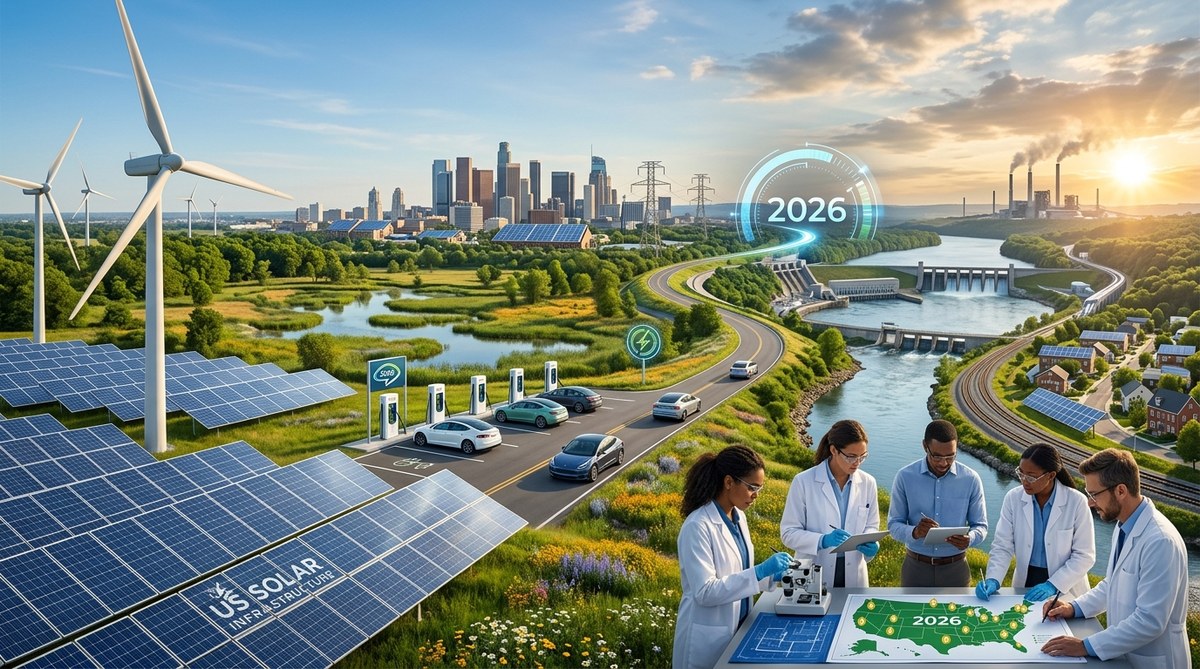
The year 2026 is not just another year on the calendar. For anyone tracking climate action in the United States, it feels like the moment when the rubber finally meets the road. After years of ambitious pledges, heated political debates, and steady technological progress, this is the year when many of those promises must turn into measurable results. The decisions made in Washington, in state capitals, and in communities across the country over the next twelve months will likely determine whether the United States can bend its emissions curve fast enough to meet its commitments under the Paris Agreement. It is a heavy weight for a single year to carry, but the convergence of policy deadlines, election outcomes, and market forces has made 2026 the most consequential year for American climate policy in a generation.
2026 marks a critical inflection point for climate action in the United States. With major policy deadlines approaching, record breaking clean energy investments, and a new administration shaping federal direction, this year will determine whether the nation can meet its emissions targets. From state led initiatives to community resilience projects, the decisions made in 2026 will echo for decades. Understanding these dynamics is essential for anyone tracking US climate progress, evaluating policy impacts, and planning effective advocacy strategies.
The Stakes in 2026: Why This Year Matters More Than Any Other
You have probably heard people say that every year is the most important year for climate action. In 2026, that claim actually holds up under scrutiny. The United States submitted its updated Nationally Determined Contribution (NDC) under the Paris Agreement, and the clock is now ticking to show real progress. Federal agencies are under pressure to prove that the Inflation Reduction Act (IRA) investments are yielding tangible emission cuts. Meanwhile, a new presidential administration has taken office, bringing a fresh set of priorities, executive orders, and regulatory approaches.
The combination of these forces creates a unique window. On the one hand, the IRA has already poured billions of dollars into clean energy manufacturing, electric vehicle infrastructure, and community solar projects. On the other hand, political headwinds at the federal level could slow or redirect some of that momentum. That is why state and local action has never been more important. When federal leadership wavers or shifts direction, states become the laboratories where climate policy either survives or stalls.
Three Major Policy Deadlines Hitting in 2026
The calendar in 2026 is packed with milestones that will shape the trajectory of US climate action. Here are three of the most significant deadlines to watch:
-
The 2026 NDC Progress Review. Every five years, nations that signed the Paris Agreement must report on their progress toward their emission reduction targets. The United States pledged to cut emissions 50 to 52 percent below 2005 levels by 2030. The review in 2026 will serve as an early check on whether the country is on track. If the data shows a shortfall, it will trigger intense pressure from international allies and domestic advocacy groups to accelerate action.
-
IRA Tax Credit Expiration and Extension Debates. Many of the tax credits and incentives in the Inflation Reduction Act were designed with specific timelines. In 2026, lawmakers will begin debating which provisions to extend, modify, or let expire. The outcome of those debates will directly affect the pace of solar and wind deployment, battery storage adoption, and electric vehicle sales. Businesses and utilities are watching these discussions closely before committing to long term investments.
-
State Level Renewable Portfolio Standard Deadlines. Several states, including California, New York, and Illinois, have set 2026 as an interim target year for specific renewable energy benchmarks. For example, California’s goal of reaching 60 percent renewable electricity by 2030 includes important checkpoints in 2026. Missing these interim targets would signal that the larger 2030 goals are at risk, prompting regulatory adjustments and renewed urgency.
How States Are Driving Climate Action Forward
While federal policy grabs the headlines, the real engine of climate action in 2026 is at the state level. State governments are not waiting for Washington to act. They are passing their own laws, setting their own emission targets, and funding their own clean energy programs. This decentralized approach has both strengths and weaknesses, but in 2026 it is producing results.
- California continues to lead with its Advanced Clean Cars II rule and its aggressive push for zero emission buildings.
- New York is investing heavily in offshore wind and has enacted a nation leading building performance standard.
- Texas generates more wind power than any other state and is now adding utility scale solar at a staggering rate.
- Colorado and New Mexico are pairing renewable energy expansion with strong environmental justice provisions.
- Michigan and Minnesota have passed comprehensive clean energy bills that include 100 percent clean electricity targets.
To see how these state approaches compare, look at the table below.
Comparing State Climate Strategies in 2026
| State | Primary Focus | Key 2026 Target | Notable Policy Tool |
|---|---|---|---|
| California | Transportation & Buildings | 60% renewable electricity by 2030 (interim checkpoint) | Advanced Clean Cars II, building electrification mandates |
| New York | Offshore Wind & Building Performance | 9,000 MW of offshore wind by 2035 | Climate Leadership and Community Protection Act |
| Texas | Utility Scale Wind & Solar | No binding state target, but market driven growth | Competitive renewable energy zones, deregulated market |
| Colorado | Environmental Justice & Clean Grid | 100% clean electricity by 2040 | Greenhouse Gas Pollution Reduction Roadmap |
| Michigan | Clean Electricity & Manufacturing | 100% clean electricity by 2040 | Clean Energy and Jobs Act |
Each of these states is proving that climate action does not require unanimous federal support. They are building coalitions of utilities, businesses, and community groups to move forward. If you want to see how local efforts can drive national change, read about how communities can lead the way in climate change adaptation.
The Technology That Is Making It Possible
Policy alone cannot deliver the emission reductions the United States needs. Technology must do the heavy lifting. And in 2026, the technology landscape looks more promising than ever. Solar and wind are now the cheapest sources of new electricity generation in most of the country. Battery storage costs have fallen dramatically, making it possible to store renewable energy for use when the sun is not shining and the wind is not blowing. Electric vehicles are approaching price parity with gasoline powered cars, and charging infrastructure is expanding.
One area that deserves special attention is the integration of small scale renewable energy into urban environments. Rooftop solar, community solar gardens, and building integrated wind turbines are making it possible for cities to generate their own clean power. These innovative ways to integrate small-scale renewable energy into urban living are reducing strain on the grid and lowering electricity bills for residents.
“The technology we have right now in 2026 is good enough to get us most of the way to our 2030 climate goals. The challenge is no longer about invention. It is about deployment, permitting, grid interconnection, and workforce training. We need to build faster.” — Dr. Sarah Kim, Director of Clean Energy Deployment at the National Renewable Energy Laboratory
This quote from Dr. Kim captures the core challenge of 2026. The solar panels, wind turbines, batteries, and heat pumps exist. They work. They are cost effective. The bottleneck is now about how quickly we can install them, connect them to the grid, and train the workers to do the job. That is a logistical and political challenge, not a technological one.
Businesses also have a major role to play. Companies of all sizes are setting science based targets and investing in renewable energy to power their operations. If you run a business or advise one, you might want to review these top 5 sustainable practices for businesses to reduce carbon emissions. Many of them require very little upfront capital and deliver savings within the first year.
What Communities and Individuals Can Do Right Now
It is easy to look at the scale of the climate challenge and feel small. But 2026 is also a year when individual and community actions add up in meaningful ways. The most effective thing you can do is focus on areas where you have direct control and where your efforts can multiply.
For households, that means electrifying everything you can. Switch from a gas furnace to a heat pump. Replace your gas stove with an induction model. Install solar panels if your roof gets good sun. These upgrades lower your carbon footprint and save you money over time. Many of them qualify for federal tax credits and state rebates that are still available in 2026.
For neighborhoods and community groups, consider organizing around a shared solar installation or a neighborhood electric vehicle charging hub. Collective purchasing can bring down costs for everyone. Some cities offer grants for community led climate projects. If you live in an urban area, you might find inspiration in these innovative strategies to reduce carbon footprints in urban areas, which cover everything from green roofs to car share programs.
For advocates and policy analysts, 2026 is the year to show up at public hearings, submit comments on proposed regulations, and support candidates who prioritize climate action at every level of government. Local elections often have lower voter turnout, which means your voice carries more weight. City council races, school board elections, and state legislative contests all affect climate policy in tangible ways.
The Road Ahead for Climate Action in 2026 and Beyond
Nobody has a crystal ball, but a few things are clear about the path forward. The United States will not solve the climate crisis in a single year. But 2026 will set the trajectory for the rest of the decade. If the country can demonstrate that it is serious about its emission reduction targets, it will build credibility on the world stage and attract even more private investment. If it stumbles, the window for keeping global warming below 1.5 degrees Celsius will narrow considerably.
The good news is that the momentum is real. Solar installations are breaking records. Electric vehicle sales are climbing. States are passing ambitious laws. Communities are organizing. And the technology keeps getting better and cheaper. The work is not easy, but it is straightforward. Reduce emissions. Build clean energy infrastructure. Protect vulnerable communities. Repeat.
Whether you are a policy analyst tracking federal regulations, an activist organizing your neighbors, or a concerned citizen trying to make sense of the news, you have a part to play in 2026. Stay informed. Stay engaged. And keep pushing for the future you want to see. The year ahead will test the United States in ways that few years have before, but it also offers an opportunity to prove that collective action, guided by science and driven by determination, can still change the course of history.