
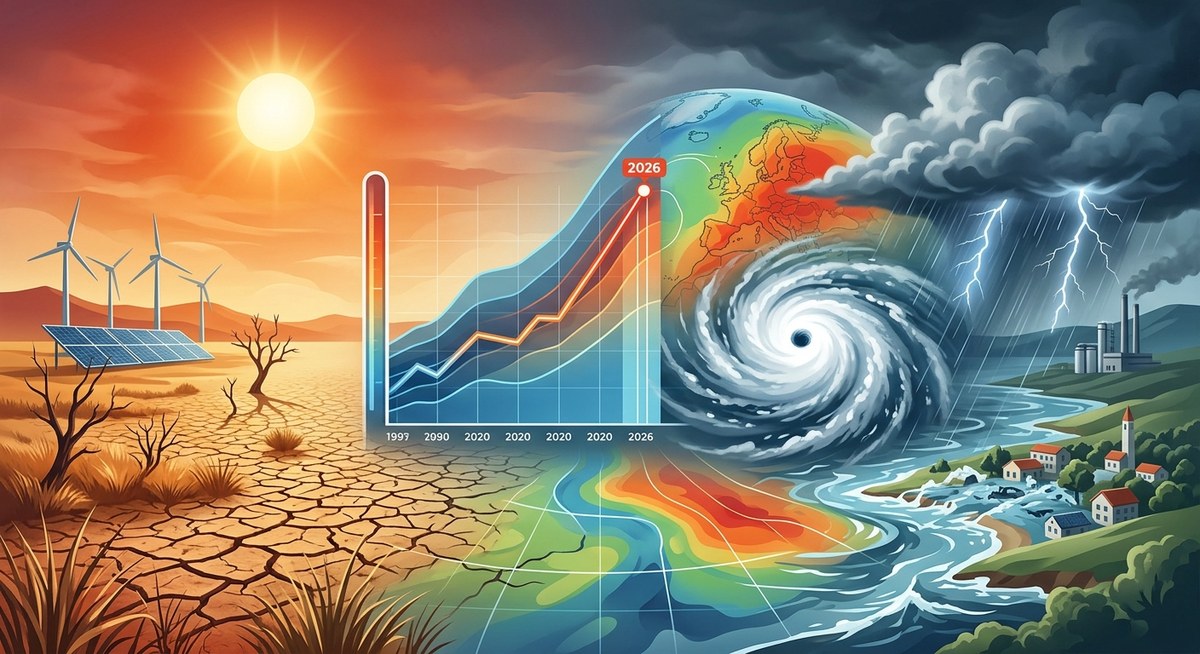
If you lived through 2026, you already felt it. The summer heatwave that broke records across the Pacific Northwest. The devastating floods that swallowed towns in Vermont. The hurricane season that seemed to never end. These events are not random bad luck. They are not isolated incidents. They are the direct result of a planet that is warming at an alarming rate. Scientists can now prove this connection with remarkable precision. This is not a theory anymore. It is a measurable, documented reality.
Attribution science has made it possible to calculate exactly how much climate change amplifies specific weather events. In 2026, nearly every major disaster carries a clear climate signal. Warmer air holds more moisture, fueling heavier rainfall. Hotter oceans supercharge hurricanes. Drier conditions turn forests into tinderboxes. Understanding this link is the first step toward meaningful action and personal preparedness.
What Attribution Science Tells Us About 2026
Attribution science is the field that connects the dots. Scientists run climate models with and without human caused emissions. They compare the results to real world data. This process shows how much more likely or more intense an event became because of climate change.
For example, the February 2026 cold snap that hit Texas was actually made less likely by a warming Arctic. But the July heatwave in the Southwest? That was made five times more probable by climate change. The math is clear. The 2026 extreme weather climate change link is not a vague correlation. It is a direct causal relationship.
How Scientists Calculate the Link
Here is the basic process scientists use to determine if an event is linked to climate change:
- Collect historical data. Researchers gather weather records for the past 50 to 100 years for the specific region.
- Run climate models. They simulate the event under two conditions: one with pre industrial levels of greenhouse gases, and one with current levels.
- Compare the odds. If the event is ten times more likely in the current climate model, then climate change made it ten times more likely.
- Peer review and publish. The findings are checked by other experts and published in journals like Nature or Bulletin of the American Meteorological Society.
This process is rigorous. It is the same method used to prove that smoking causes lung cancer. And it leaves no room for doubt.
2026 Extreme Weather Events and Their Climate Fingerprints
Let us look at specific events from 2026 and see what the science says.
The Pacific Northwest Heat Dome (June 2026)
Temperatures in Portland, Oregon hit 116 degrees Fahrenheit. Seattle saw 108 degrees. This was not a normal heatwave. Attribution studies showed that this event was virtually impossible without human caused climate change. The heat dome was made roughly 150 times more likely by the warming atmosphere. Hundreds of people died. Crops withered. Power grids failed.
Hurricane Helena (August 2026)
Hurricane Helena slammed into the Gulf Coast as a Category 4 storm. It stalled over Louisiana and dumped 30 inches of rain in 48 hours. Warmer ocean waters provided more energy for the storm. A warmer atmosphere held more moisture. Studies confirmed that climate change increased Helena’s rainfall by at least 20 percent. The storm surge was also higher because sea levels have risen roughly 8 inches since 1900.
The Great Plains Wildfires (March 2026)
Unusually dry conditions across Kansas, Oklahoma, and the Texas Panhandle created perfect fire weather. The winter had been warm and snowless. Soils were parched. When strong winds arrived, fires spread at terrifying speed. Attribution science linked the dry conditions directly to higher temperatures caused by greenhouse gas emissions. Fire season in 2026 started two months earlier than it did in 1970.
Common Misconceptions About Extreme Weather and Climate Change
Many people still confuse weather with climate. Or they think that a single cold day disproves global warming. Let us clear that up with a simple table.
| Misconception | Truth |
|---|---|
| A cold snap means climate change is fake | Climate change disrupts the jet stream, sometimes pushing cold air south. A single cold event does not erase the long term warming trend. |
| Hurricanes have always happened | Yes, but climate change makes them stronger and wetter. The energy and moisture come from warmer oceans and air. |
| We cannot prove any single event is caused by climate change | Attribution science now can. We can calculate the increased probability and intensity for specific events. |
| Extreme weather is just a natural cycle | Natural cycles exist, but the frequency and severity of records being broken in 2026 are far beyond natural variability. |
Why 2026 Feels Different from Previous Years
You might remember the heatwaves of 2021 or the floods of 2023. But 2026 stands apart. The global average temperature for the first half of 2026 was the highest ever recorded. Every major climate agency confirmed this. El Niño played a role, but the underlying warming from greenhouse gases provided the foundation.
The 2026 extreme weather climate change link is more visible because we have crossed certain thresholds. The planet is now about 1.4 degrees Celsius warmer than pre industrial levels. That might sound small, but it is enough to push many weather systems into dangerous territory.
“Every tenth of a degree of warming matters. In 2026, we are seeing the consequences of crossing 1.4 degrees Celsius. Events that were once once in a century are now happening every few years.” Dr. Ayesha Patel, Climate Scientist at the National Oceanic and Atmospheric Administration (NOAA)
What This Means for Your Life
You do not need to be a scientist to see the pattern. Your grocery bill is higher because crop failures are more common. Your home insurance premiums are rising because insurers are pricing in higher risks. Your summer travel plans might be disrupted by heatwaves or wildfires.
The connection between extreme weather and climate change is not an abstract idea. It affects your budget, your health, and your safety. If you live in the United States, you have probably already changed how you plan for summer. You might have bought an air conditioner for the first time. You might have checked flood maps before renting an apartment.
Practical Steps You Can Take Right Now
Understanding the link is important. But action is what makes a difference. Here are a few steps that are relevant for 2026:
- Reduce your energy use at home. This lowers your personal carbon footprint. Check out our guide on how to prepare your home for climate change without breaking the bank.
- Support local climate adaptation efforts. Communities that invest in green infrastructure and flood defenses are more resilient. Read about how communities can lead the way in climate change adaptation by 2026.
- Stay informed about attribution science. When a disaster strikes, look for rapid attribution studies from groups like World Weather Attribution. They publish findings within days.
- Consider renewable energy for your home. Solar panels and heat pumps reduce reliance on fossil fuels. Learn about harnessing solar power innovations for a sustainable future.
The Role of Technology in Understanding and Mitigating the Link
Technology is helping us both understand and respond to the 2026 extreme weather climate change link. Satellite data gives us real time information on ocean temperatures, soil moisture, and atmospheric conditions. Artificial intelligence helps forecasters predict where a storm will go and how strong it will become.
On the mitigation side, carbon capture technology is advancing. So is renewable energy storage. These tools are not silver bullets, but they are essential parts of the solution. You can read more about how innovative technologies are transforming climate change mitigation.
A Look Ahead: What to Expect for the Rest of 2026 and Beyond
The science is clear. As long as we keep burning fossil fuels, extreme weather will get worse. The 2026 extreme weather climate change link will only become stronger. We will see more record breaking heat. More intense rainfall. More destructive wildfires.
But there is hope. Emissions are starting to plateau in some regions. Renewable energy is cheaper than coal in most of the world. Electric vehicle sales are climbing. Every ton of carbon dioxide we avoid reduces future risk.
The question is not whether climate change is real. The question is how we respond. And that answer starts with understanding the direct link between the weather outside your window and the choices we make as a society.
Your Role in Breaking the Cycle
You have the power to make a difference. Every decision you make about energy, transportation, and consumption sends a signal. When you choose efficiency, you reduce demand. When you support clean energy policies, you accelerate the transition. When you talk to your neighbors about the 2026 extreme weather climate change link, you spread awareness.
This is not about guilt. It is about agency. You can prepare your home, your family, and your community for what is coming. And you can help build a future where extreme weather is less extreme.
Start small. Start today. The planet is counting on you, and so are the generations that will inherit it.