
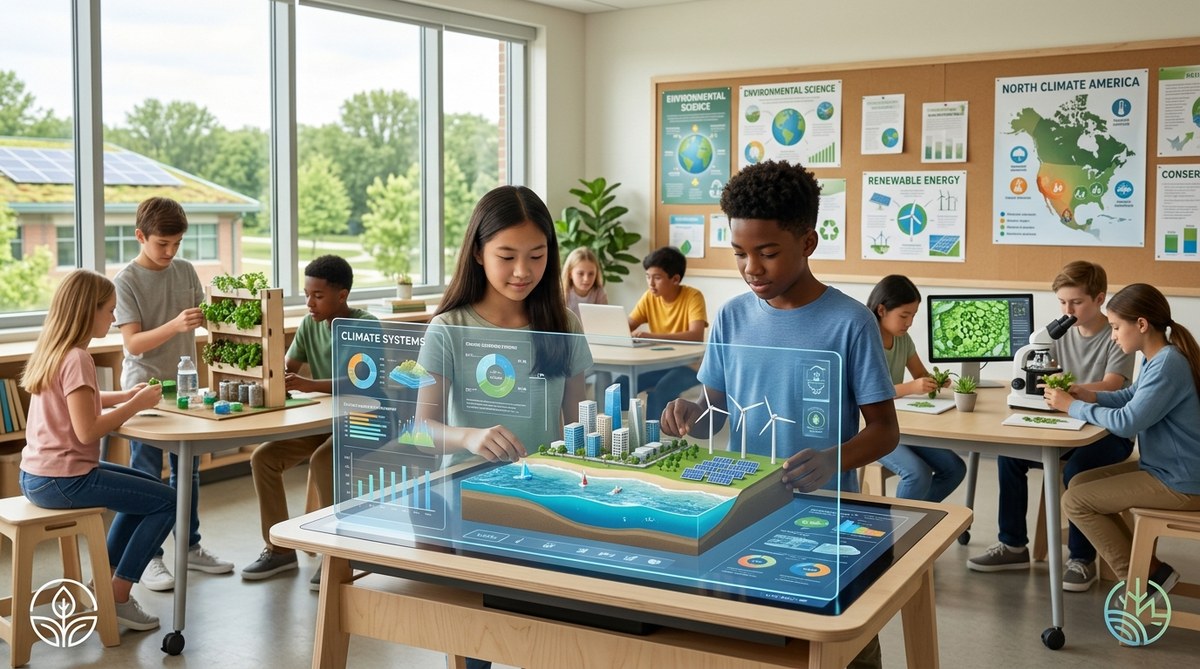
A third grader in Oregon is planting native milkweed on the school’s rooftop garden while measuring soil moisture with sensors. A high school junior in Florida is using satellite data to model sea level rise. A freshman at Arizona State is analyzing local heat island data to propose cooling strategies for her campus. This is not a future scenario. This is what climate change education looks like in 2026 across the United States. It is hands on, interdisciplinary, and no longer a side note in science class. It is woven into reading, social studies, math, and even art. And it is changing how students see the world and their role in it.
By 2026, climate change education has moved from elective to essential in American classrooms. Schools now integrate climate topics across K-12 subjects, mandate climate literacy standards, and embrace project-based learning. College programs offer dedicated degrees and interdisciplinary minors. Teachers receive training on climate science and emotional resilience. The shift is driven by student demand, state policies, and the urgent need to prepare a climate ready workforce.
Why 2026 Became the Tipping Point for Climate Education
The year 2026 marks a turning point. More than half of U.S. states have adopted climate literacy standards. New Jersey and Connecticut were early movers, but now states like Oregon, Colorado, and California have expanded curriculum requirements. The push comes from three sides: students marching for action, employers needing green skills, and educators realizing that climate change touches every subject. A 2025 survey from the National Education Association found that 78% of teachers already discuss climate change in their classrooms, whether or not it is in the official syllabus.
The federal government has also stepped in. The Department of Education launched a Climate Education Corps in early 2026, placing trained specialists in high need districts. This program provides resources, lesson plans, and direct support for teachers who want to build climate literacy but lack confidence in the science.
What Changed in K-12 Curricula
Schools are no longer treating climate change as a single unit in earth science. Instead, it acts as a lens through which students learn core subjects.
English Language Arts
Students read nonfiction articles about wildfires, debates about carbon pricing, and novels like “The Water Will Come” or “The Ministry for the Future.” They write persuasive essays on local climate policies and create public service announcements for their communities.
Math
Real world data sets are replacing generic word problems. Middle schoolers calculate average temperature anomalies and graph them. High school students use algebraic models to predict renewable energy adoption rates or analyze the cost benefit of heat pump installation.
Social Studies
History classes now include the story of environmental justice. Students study the Dust Bowl alongside modern drought patterns and connect the fossil fuel industry’s influence to geopolitical conflicts. Civics projects involve students proposing climate adaptation plans for their own towns.
Science
This is the most obvious shift. Biology classes examine phenology shifts and coral bleaching. Chemistry classes analyze atmospheric CO2 using open source data. Physics students design and test small scale wind turbines or solar chargers.
One standout example is the Climate Action Project used by over 15,000 schools globally. Students collaborate with peers in other countries to design local solutions and then present their work at regional sustainability fairs.
How Climate Change Education Is Taking Root in Higher Education
Universities have moved beyond offering a single elective on global warming. By 2026, more than 200 colleges have launched degrees or certificates in climate science, climate policy, or climate resilience. Community colleges lead the way in training technicians for solar installation, energy auditing, and green building.
A growing trend is the “climate across the curriculum” approach. At the University of Michigan, for example, students in the business school analyze carbon supply chains, while art students create installations about melting glaciers. This interdisciplinary model prepares graduates for a workforce where every sector will be affected by climate change.
“We are no longer asking whether climate change belongs in the classroom. The question is how to do it well. The best approaches are grounded in local context, give students agency, and connect action with learning.”
– Dr. Maria Lopez, director of the Center for Climate Education at Teachers College, Columbia University
Four Steps to Integrate Climate Change Education in Your School
If you are an educator or administrator looking to strengthen climate education in your school or district, here is a practical process that schools across the country have used.
- Assess your starting point. Survey teachers to see what they already cover and where they feel unprepared. Identify existing strengths, like a strong science department or a supportive community partner such as a local nature center.
- Align with state or district standards. Check if your state has adopted climate literacy benchmarks. If not, use the Next Generation Science Standards or the Cloud Institute’s framework as a guide. Map climate topics to existing standards in science, math, and social studies.
- Invest in professional development. Teachers need more than a one hour workshop. Look for sustained programs like those offered by the National Oceanic and Atmospheric Administration (NOAA) or the Climate Literacy and Energy Awareness Network (CLEAN). In 2026, several districts have created paid summer institutes for climate education.
- Start with a pilot project. Choose one grade level or subject team to develop a climate integrated unit. Measure student engagement and learning outcomes. Then use that success to expand across the school.
Key Benefits of a Climate Integrated Curriculum
Here are the main advantages schools report after embedding climate change education:
- Students develop critical thinking by evaluating complex, real world problems with no simple answers
- Engagement increases because the topic is personal and urgent for many young people
- Career readiness improves as students gain skills in data analysis, systems thinking, and communication
- Emotional resilience grows when students move from anxiety to empowered action
- Community ties strengthen through local projects and partnerships with environmental organizations
Common Mistakes Schools Make (and How to Avoid Them)
Even well intentioned efforts can go wrong. The table below outlines typical pitfalls and better approaches.
| Mistake | Better Approach |
|---|---|
| Only teaching doom and gloom scenarios | Balance urgency with hope; highlight solutions and community action |
| Treating climate change as a science only topic | Integrate across subjects: literature, history, art, civics |
| Using outdated data or denying mainstream science | Rely on peer reviewed sources like NASA and NOAA |
| Ignoring the emotional impact on students | Include time for reflection, discussion, and mental health support |
| Focusing solely on global problems without local connection | Use your own region’s climate impacts and nearby solutions |
| Preparing students for a future that doesn’t include them | Empower students to act now, through school projects and civic engagement |
The Role of Technology in Modern Climate Education
Teachers in 2026 have a wide array of digital tools at their fingertips. Platforms like Explore Science allow students to access real time satellite imagery of deforestation, glacier retreat, and urban heat islands. Virtual reality field trips let a class in Nebraska walk through a flooded Louisiana bayou or a solar farm in the Mojave Desert.
Data visualization tools help students make sense of complex climate models. Many schools use En-ROADS, a global climate simulator developed by Climate Interactive and MIT. Students adjust variables like carbon pricing or renewable energy subsidies and see the projected temperature change by 2100.
Schools are also using gamification. The Mission Zero game challenges students to reduce a virtual city’s carbon footprint while balancing economic and social needs. These technologies make abstract concepts tangible and foster systems thinking.
But technology alone is not enough. The most effective classrooms pair digital tools with hands on experiences: planting trees, conducting energy audits of their school building, or testing local water quality. For a deeper look at how communities are leading local adaptation efforts, see our article on
Addressing Emotional and Mental Health
Teaching about climate change can stir anxiety, especially among younger students. A 2025 study in The Lancet Planetary Health found that 60% of teens in the U.S. feel worried or helpless about climate change. Schools in 2026 are now embedding emotional resilience into climate education.
Teachers use strategies like “hope circles” where students share what they are doing to help, or “action projects” that channel worry into tangible results. Many schools partner with mental health professionals to support students who experience climate distress. This approach recognizes that education is not just about facts; it is about preparing young people to thrive in a changing world.
If you want to explore the mental health side more, read our piece on
What Policymakers and Parents Should Know
For state legislators, school board members, and parents, the message is clear. Climate change education is not a partisan issue. It is a practical necessity. Students who understand climate science and solutions will be better prepared for jobs in renewable energy, sustainable agriculture, urban planning, and countless other fields. They will also be more informed voters and community members.
Several states now require climate literacy for high school graduation. New York passed a law in 2025 mandating at least 15 hours of climate instruction per year in grades K-12. Similar bills are under consideration in at least a dozen more states. Parents can support this by talking with their children about climate topics, visiting local parks and farms, and advocating for updated curriculum at school board meetings.
Looking Ahead: Where Climate Education Is Headed After 2026
The next few years will likely see even deeper integration. Expect more partnerships between schools and local utilities, farms, and tech companies. Artificial intelligence may soon help personalize climate learning pathways for each student. And as the number of climate related disasters rises, students will increasingly learn about resilience and emergency preparedness.
But the biggest change is cultural. Climate change education in 2026 is no longer about scaring students into action. It is about giving them the tools to build a better world. Every lesson, from fractions to fiction, can carry a thread of climate literacy. And every student deserves to graduate knowing that they have a role to play.
Whether you are a teacher planning next week’s lesson, a parent helping with a science fair project, or a policymaker rewriting standards, remember this: every conversation about climate is a seed. Water it with truth, action, and hope. Watch what grows.