
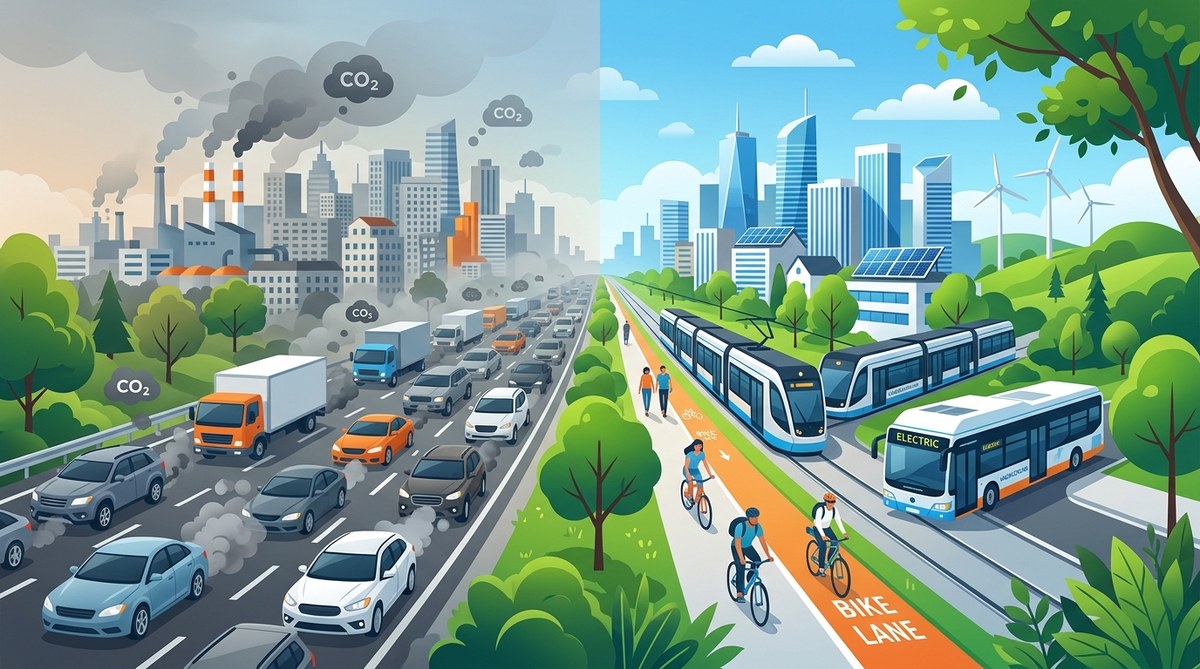
Every morning you grab your keys, step out the door, and join millions of other Americans sitting in traffic. That routine seems harmless enough. But by the time you park at the office, your car has already released about 19 pounds of carbon dioxide. Multiply that by 260 working days a year, and the number gets staggering. The truth is that the way we get to work is one of the biggest pieces of our personal carbon footprint. And the good news? Small changes make a real dent.
Your daily commute is a major source of greenhouse gas emissions, but you don’t have to quit your job or buy a new car to fix it. Swapping one car trip a week for public transit, biking, or carpooling can reduce your annual carbon footprint by hundreds of pounds. Combining smarter driving habits with remote work days and low emission vehicles creates a ripple effect that helps slow climate change.
The Hidden Climate Cost of Getting to Work
Transportation is the largest source of greenhouse gas emissions in the United States. According to the EPA, passenger cars and light trucks produce about 58% of those transport emissions. Most of that comes from the daily grind. Driving alone to an office five days a week adds roughly 4.6 metric tons of CO2 per year per vehicle. That is nearly as much as the total annual emissions from an average home’s electricity use.
Traffic jams make things worse. When cars sit in stop and go traffic, fuel efficiency drops. An engine idling for more than 10 seconds uses more fuel than restarting it. So those minutes you spend creeping along the interstate are burning extra gasoline without moving you any closer to work. And heat waves, which are becoming more common in the US because of climate change, make air conditioning run harder, which uses even more fuel.
How Your Commute Contributes to Climate Change
The connection is straightforward: burning gasoline releases CO2. But there are a few angles that matter for everyday commuters.
- Personal vehicle emissions are the biggest contributor. The average car emits about 404 grams of CO2 per mile. A 30 mile round trip means over 12 kg of CO2 daily.
- Traffic congestion increases emissions by 25 to 50% compared to free flowing traffic. Deceleration and acceleration burn more fuel.
- Idling wastes fuel. Ten minutes of idling per day adds up to about 26 gallons of wasted gas per year.
- Single occupancy vehicles are the norm. About 76% of US commuters drive alone. That means three empty seats per car on average.
Table: Compare Commute Options by Carbon Footprint
| Commute mode | CO2 per mile (grams) | Annual emissions (10 mile one way) | Notes |
|---|---|---|---|
| Driving alone (gas) | 404 | 2.6 metric tons | Average sedan, 22 mpg |
| Carpool (2 people) | 202 | 1.3 metric tons | Splitting the ride cuts emissions in half |
| City bus | 150 | 1.0 metric tons | Per passenger, varies by route |
| Hybrid car | 260 | 1.7 metric tons | Toyota Prius or similar |
| Electric vehicle | 100 | 0.65 metric tons | Grid average, varies by region |
| E bike | 10 | 0.06 metric tons | Includes electricity for charging |
| Walking / bike | 0 | 0 | Best option for health and planet |
“Shifting just 10% of solo drivers to public transit could cut US transportation emissions by the equivalent of taking 20 million cars off the road.”
— National Academy of Sciences, 2025 report on urban mobility
Five Practical Ways to Decarbonize Your Commute
You don’t need a complete life overhaul to make a difference. Here are five steps that work for real people with real schedules.
-
Try a hybrid schedule with remote work. Many companies in 2026 still offer one or two remote days a week. Skipping the commute on Wednesday alone saves nearly 20% of your weekly driving emissions. If your employer is hesitant, share the savings data. Companies that embrace flexible work see lower turnover and happier employees.
-
Switch to an electric or plug in hybrid vehicle. The upfront cost is still higher than a gas car, but federal tax credits and state rebates bring the price down. Electricity costs about half as much per mile as gasoline. Over five years, an EV owner saves roughly $4,000 on fuel. And charging at home is convenient. Check out our guide on https://localcooling.com/harnessing-solar-power-innovations-for-a-sustainable-future/ to pair your EV with solar panels for near zero carbon driving.
-
Carpool with coworkers or use ride share apps that offer carpool matching. Apps like Waze Carpool and local programs connect drivers with riders going the same direction. Even carpooling two days a week cuts your emissions by 40%. Plus, you can use the HOV lane and shorten your travel time.
-
Use public transit for part of your route. Park and ride lots let you drive to a train station and take the bus or light rail the rest of the way. Many US cities have expanded transit options in 2026 thanks to infrastructure funding. A monthly transit pass often costs less than a week of gas.
-
Invest in an e bike or electric scooter for short commutes. A 10 mile trip on an e bike takes about 30 minutes. No parking fees, no traffic stress, and zero tailpipe emissions. Many employers offer subsidies for micromobility. If you live within 15 miles of work, this is often the fastest and cheapest option.
Small Habits That Multiply Into Big Savings
Beyond changing your mode of transport, a few tweaks to your daily driving habits can lower your footprint.
- Keep your tires properly inflated. Under inflated tires reduce fuel economy by up to 3%.
- Avoid aggressive acceleration and hard braking. Smooth driving improves mileage by 15 to 30% on the highway.
- Remove roof racks and cargo boxes when not in use. They create drag and waste fuel.
- Combine errands into one trip. Several short trips from a cold start use more fuel than one longer trip.
- Use cruise control on highways to maintain constant speed.
- Turn off your engine if you are stopped for more than 30 seconds. Restarting uses less fuel than idling.
The Role of City Planning and Technology
Individual actions are powerful, but systemic change amplifies them. Cities across the United States are investing in bike lanes, bus only corridors, and bike share programs. In 2026, several major metro areas have adopted congestion pricing, charging drivers a fee to enter downtown during peak hours. The revenue funds public transit improvements. These policies make alternatives more attractive and reduce overall traffic.
Technology also speeds up the shift. Ride hailing companies now offer electric vehicle only options. Car sharing services like Zipcar and Turo let you rent a hybrid for the days you need a car. And real time transit apps make bus and train schedules easier to navigate. For a deeper look at how innovation is reshaping urban mobility, read about
Why 2026 Is the Right Time to Change Your Commute
Climate scientists say this decade is critical for bending the emissions curve. The transportation sector is the low hanging fruit. Switching to an electric bike or taking the bus twice a week might feel small, but when millions of Americans make similar choices, the effect is huge. Plus, you save money, reduce stress, and often get a little exercise.
Your daily commute doesn’t have to be a carbon guilt trip. Pick one idea from this list and try it for a month. Maybe it is a hybrid work week. Maybe it is an e bike. Maybe it is just adjusting your driving style. Whatever you choose, you are part of the solution. And that feels pretty good.