
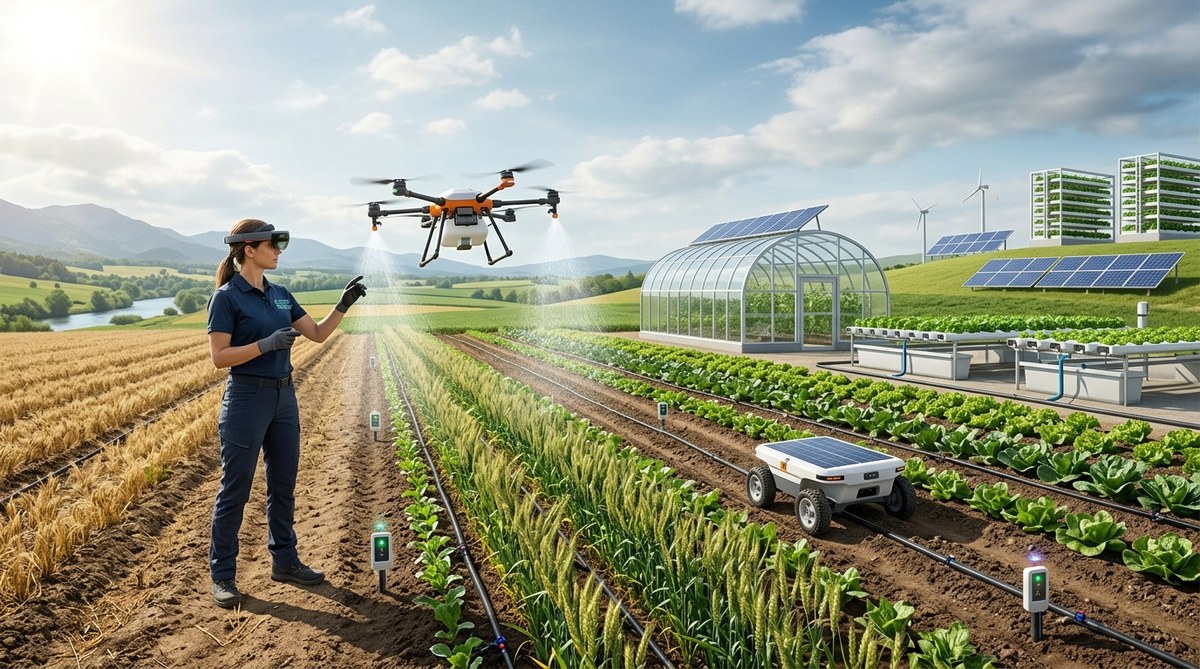
The growing season of 2026 looks different than it did a decade ago. You feel it in the soil that dries out faster, in the unexpected hailstorms that flatten a field overnight, and in the price of irrigation water. Farmers, researchers, and policymakers across the United States are staring at a hard truth: the old playbook is cracking. But something else is happening too. Out of that pressure, a wave of climate change agricultural innovation is rising. It is not just about surviving anymore. It is about growing smarter, cleaner, and more profitably in a world that keeps heating up.
Climate change is forcing American agriculture to reinvent itself. Innovations ranging from AI-driven soil sensors to drought-tolerant gene-edited crops are helping farms cut emissions, conserve water, and maintain yields. This article walks you through the top technologies and practices, gives you a simple adoption roadmap, and shows what works for real growers in 2026.
The Pressure Cooker: Why Climate Change Demands New Farm Tools
You do not need a scientist to tell you the seasons are off. In the Midwest, spring rains arrive later and heavier. In California, snowpack is thinner, and the wildfire season eats into harvest windows. The USDA’s 2026 climate report estimates that extreme weather events are now costing U.S. agriculture over $15 billion per year in lost production. That number is climbing.
At the same time, the clock is ticking on greenhouse gas reductions. Agriculture accounts for roughly 10% of U.S. emissions, mostly from livestock, fertilizer use, and soil management. Consumers and regulators are pushing for change. Large food buyers like Walmart and Nestlé have set 2030 carbon reduction targets that ripple back to the farm gate.
This double bind is the engine behind climate change agricultural innovation. It is not a theory. It is a business necessity.
From Seed to Sensor: Key Innovations Reshaping Agriculture
Precision Agriculture That Thinks for Itself
Walk into a modern tractor cab and you will see a tablet glowing with real time data. Precision agriculture uses GPS, satellite imagery, and soil sensors to apply water, fertilizer, and pesticides exactly where they are needed. No guesswork. No waste.
One standout tool in 2026 is the variable rate irrigation system. It reads moisture levels across a field and waters only the dry zones. Early adopters in Nebraska report cutting water use by 30% while keeping yields steady. That is a direct hedge against drought.
Another leap is the use of AI powered drones. They can spot a fungal infection in a cornfield before a human eye can see it. The drone then tells the sprayer to target only that patch. This slashes chemical runoff and saves money.
For a deeper look at how these systems fit into a larger sustainability plan, see our guide on innovative strategies to reduce carbon footprints in urban areas. The principles of precision apply far beyond rural fences.
Gene Editing: Crops Built for a Hotter World
Traditional plant breeding takes a decade. Climate change does not wait that long. New gene editing techniques, especially CRISPR, let scientists tweak a plant’s DNA in months. The goal is to create crops that shrug off heat, resist new pests, and use less water.
In 2026, the first CRISPR edited soybeans are being planted on commercial acres in the Midwest. They are engineered to maintain pod count even when nighttime temperatures stay above 75 degrees Fahrenheit. Early yield data shows a 15% advantage over conventional varieties in hot years.
This technology is controversial for some consumers, but federal regulators in the U.S. have cleared certain edits as non GM. The key is that no foreign DNA is introduced. It is simply accelerating what nature could do over many generations.
Controlled Environment Agriculture
During the 2023 hurricane season, many Florida tomato fields were wiped out. That same week, indoor farms in Georgia kept producing lettuce and herbs without missing a day. Controlled environment agriculture (CEA) uses greenhouses, vertical towers, and hydroponics to grow food under a protected roof. The climate inside is managed by software.
Energy use is the big hurdle. But in 2026, more CEA facilities are pairing with solar arrays and battery storage. A large vertical farm in Texas now runs entirely on renewable power. It grows leafy greens with 90% less water than a field farm and zero pesticide runoff.
The technology is not just for salad greens. Researchers are trialing indoor rice production in California, aiming to cut methane emissions from flooded paddies. If it scales, it could be a game changer for a staple crop.
Four Steps to Adopt Climate Smart Innovation on Your Farm
You do not need to buy a million dollar robot tomorrow. Start small, test, and scale. Here is a practical sequence that works for most operations.
- Audit your current resource use. Track water, fuel, electricity, and fertilizer for one full season. Identify the biggest waste spots. Many county extension offices offer free software tools for this.
- Run one pilot plot with a precision tool. Rent a sensor network or borrow a drone from a co op. Compare the pilot plot’s input costs and yield against your usual method.
- Plug into a data network. Modern tools are only as good as the data they share. Join a platform like the Climate FieldView or John Deere Operations Center to see field level analytics across your whole farm.
- Evaluate a new crop or variety. Talk to your seed dealer about drought tolerant or heat tolerant hybrids. Plant a small strip this year and measure the difference.
Each step builds confidence and data. After a year, you will know what pays off for your specific soil, weather, and market.
Techniques That Work (and Some That Don’t)
Not every innovation is a home run. Some sound good in theory but fall short in the field. The table below compares common climate smart techniques based on 2026 data from university trials.
| Technique | What It Does | Efficiency Gain | Common Pitfall |
|---|---|---|---|
| Variable rate fertilizer | Applies nutrients per zone | 20% fertilizer savings | Requires reliable soil maps |
| Cover cropping | Reduces erosion, stores carbon | 10-15% soil organic matter increase | Can delay spring planting |
| Strip tillage | Less soil disturbance | 30% fuel savings | Not suitable for all soil types |
| Automated weeding robots | Removes weeds without chemicals | 50% herbicide reduction | High upfront cost (but falling) |
| Biodegradable mulch film | Replaces plastic mulch | Eliminates plastic waste | More expensive than traditional film |
The message is clear: the best innovation is the one that fits your land and your budget. A cover crop that works in Iowa may not survive a Texas summer.
Real Talk: What Farmers Are Saying
I spoke with Maria Gutierrez, a third generation grower in California’s Central Valley. Her almond orchard has been hit by four straight years of drought. She invested in a sensor network last year. Here is her take:
“I used to water the whole block because I couldn’t see where the dry spots were. Now the app tells me exactly which trees need water and which don’t. I cut my water bill by 25% last year. The sensors paid for themselves in one season. We have to adapt or we won’t be here in ten years. It is not scary. It is just different.”
That sentiment is common. The fear of change is often bigger than the change itself.
A Practical Guide to Evaluating New Tools
When you sit down to decide which innovation to try first, use this checklist:
- Does the tool reduce my input cost (water, fertilizer, fuel)?
- Is the data easy to understand and act on?
- Does the provider offer local support or training?
- What is the payback period? (Aim for two years or less)
- Will it work with my existing equipment?
- Does it lower my risk from extreme weather?
These questions will keep you grounded. Fads come and go. But a tool that cuts your cost and your exposure to heat waves is a keeper.
For more on how energy and agriculture overlap, check out the future of renewable energy and its impact on climate resilience. Solar powered irrigation and biogas from livestock waste are two areas where that synergy is growing fast.
Where We Go From Here
Climate change agricultural innovation is not a drop in replacement for the old ways. It is a system redesign. The farmers who thrive in 2026 and beyond will be the ones who treat their fields as living, sensing systems rather than static plots of dirt.
That shift requires openness to new data, new genetics, and new business models. It also needs support from policymakers who fund research and extension services. The USDA’s Climate Smart Agriculture and Forestry Strategy, launched in 2024, has already funneled over $3 billion into practice adoption. More is needed.
As you plan your next season, think small. Try one sensor. Plant one new variety. Talk to a neighbor who already made the leap. The technology is ready. The question is whether we are ready to use it at scale.
If you want to see how urban areas are applying similar logic to cut emissions, take a look at how innovative technologies are transforming climate change mitigation. The same sensors and data principles that save water on a farm can save energy in a city.
The heat is not going away. But neither is the human drive to solve problems. That is the story of agriculture from the dust bowl to the drone age. And it is still being written.