
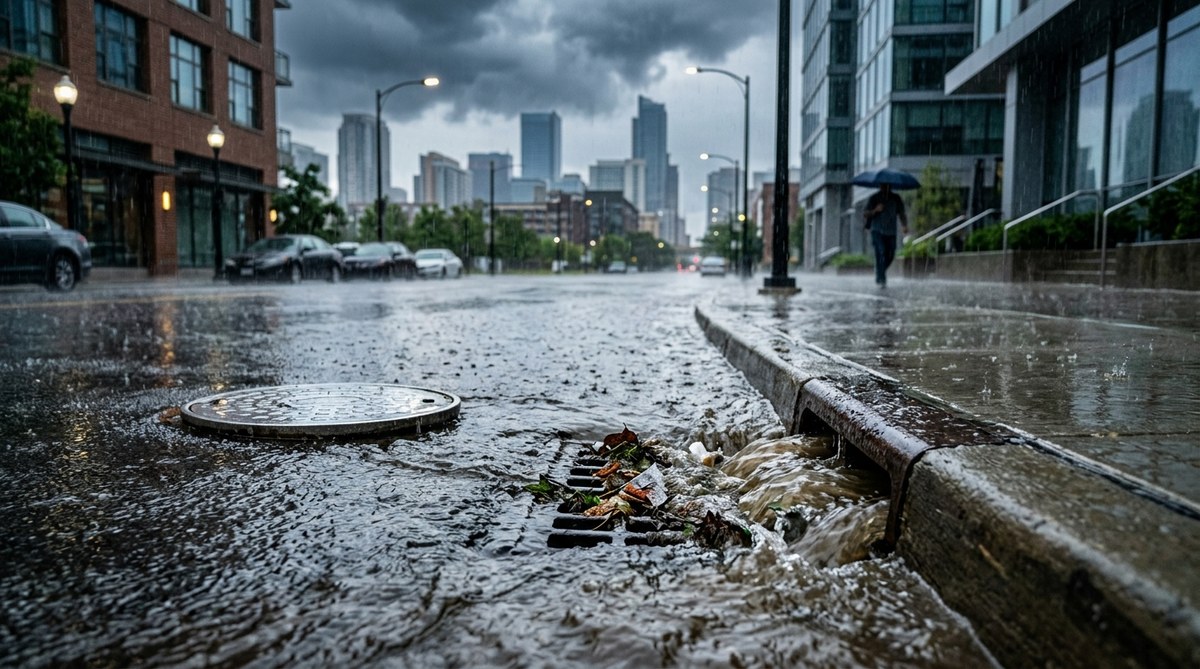
Climate change is delivering heavier, wetter storms that US storm drains were never built to handle. Aging pipes, pavement-heavy cities, and rising groundwater are pushing drainage systems past their limits. But 2026 offers a path forward through green infrastructure, updated design standards, and community-level action. Understanding these pressures helps you advocate for smarter investments and protect your neighborhood from the next big storm.
You have seen the headlines: a city block turned into a river after just three hours of rain. A basement apartment filling with water while the street drains gurgle uselessly. In 2026, these scenes are no longer rare events. They are the new normal across the United States. The reason is not just that it rains more. It is that climate change stormwater management has become a game of catch up, and our cities are losing.
The math is simple. Older storm drains were designed for a 10-year storm, meaning a rainfall event with a 10 percent chance of happening in any given year. But the climate has changed the odds. Warmer air holds more moisture, so storms that used to be 10-year events now arrive every five years, or even more often. When the rain falls faster than the ground or the pipes can absorb it, the water has nowhere to go but up. And up means into your street, your garage, and your living room.
Why Your City’s Pipes Are Older Than You Think
Most of the stormwater infrastructure in the United States was built between the 1950s and 1980s. That means many systems are approaching 50, 60, or even 70 years old. Pipes crack, joints shift, and sediment builds up. A pipe that is half full of muck cannot carry the same volume as a clean one. When a massive rain event hits, the system is already at a disadvantage.
Add to that the fact that many cities have not kept up with maintenance. The American Society of Civil Engineers gives stormwater infrastructure a D grade. Across the country, billions of dollars in repairs are backlogged. Cities are often forced to choose between fixing a water main break and replacing a failing drain. In the meantime, the storms keep coming.
The problem is not just age. It is also design. Many older systems are combined sewers, meaning they carry both stormwater and sewage in the same pipe. When the system gets overwhelmed, it discharges untreated sewage directly into rivers and lakes. This is called a combined sewer overflow, and it is a public health risk. In 2026, cities like Chicago, New York, and Boston are still struggling with this 19th-century design.
The Pavement Problem: How Concrete Makes Flooding Worse
Think about your own neighborhood. How much of the ground is covered in driveways, parking lots, roads, and rooftops? In a typical American city, that number can be 60 percent or more. All that hard surface acts like a funnel. Instead of soaking into the soil, rain runs off the pavement, picking up speed and pollutants along the way.
This is where climate change stormwater management gets tricky. You cannot just build bigger pipes everywhere. That would be incredibly expensive and disruptive. Plus, bigger pipes just move the problem downstream. The water has to go somewhere, and eventually it will overwhelm a river, a lake, or a low-lying neighborhood.
The smarter approach is to slow the water down, spread it out, and let it soak in where it falls. This is the idea behind green infrastructure. Rain gardens, bioswales, permeable pavement, and green roofs all work with nature instead of against it. They are not just nice to look at. They are working parts of a modern stormwater system.
Green Infrastructure: More Than Just a Trend
Green infrastructure is not about planting a few extra trees and calling it a day. It is a deliberate, engineered approach to managing rainwater at the source. A rain garden, for example, is a shallow depression filled with native plants. It collects runoff from a rooftop or driveway and allows it to slowly filter into the ground. This not only reduces the volume of water entering the drain system, but it also filters out pollutants like oil, heavy metals, and fertilizer.
Permeable pavement is another powerful tool. Unlike traditional asphalt, which is impervious, permeable pavement has a porous surface that allows water to pass through. It can be used for parking lots, driveways, and even low-traffic roads. Studies show that permeable pavement can capture up to 80 percent of annual rainfall, depending on the soil conditions.
Green roofs are especially valuable in dense urban areas where space is limited. They consist of a layer of vegetation planted over a waterproof membrane. They absorb rain, insulate buildings, and reduce the urban heat island effect. In cities like Portland and Philadelphia, green roofs are already making a measurable difference.
But here is the thing about green infrastructure: it works best when it is part of a larger strategy. You cannot just install one rain garden and expect it to solve everything. You need a network of small, distributed solutions that work together. And you need to maintain them. A rain garden that is clogged with leaves or a permeable pavement that has been sealed over will not do its job.
A Practical Approach to Climate Change Stormwater Management
If you are a city official, a planner, or a concerned citizen, you might be wondering where to start. The good news is that there are proven steps to make your community more resilient. Here is a practical process that works:
-
Conduct a vulnerability assessment. Map out your city’s stormwater system and identify areas that are prone to flooding. Look at the age of the pipes, the amount of impervious surface, and the projected rainfall under future climate scenarios. This will help you prioritize investments.
-
Set a stormwater utility fee. Instead of paying for stormwater out of the general fund, many cities have created a dedicated fee based on the amount of impervious surface a property has. This gives property owners a financial incentive to install green infrastructure and manage their runoff.
-
Update your design standards. Old standards were based on a stable climate. In 2026, you need to design for the future, not the past. That means using the latest rainfall data, which accounts for climate change, and building in extra capacity for the bigger storms that are coming.
-
Incentivize green infrastructure. Offer rebates, grants, or density bonuses for developers who incorporate rain gardens, green roofs, or permeable pavement into their projects. Many cities have seen great success with these programs.
-
Engage the community. Flooding does not stop at property lines. It is a shared problem that requires a shared solution. Hold public meetings, create educational campaigns, and work with neighborhood associations to build support for stormwater projects.
What You Can Do at Home
You do not need to be a city planner to make a difference. There are plenty of things you can do on your own property to reduce your contribution to the problem. Here are some ideas:
- Disconnect your downspouts. Make sure they are directing water away from your foundation and into a permeable area, like a lawn or garden.
- Install a rain barrel. This captures water from your roof that you can use to water your plants during dry spells.
- Plant a rain garden. Even a small one can make a difference. Choose native plants that are adapted to your local climate.
- Replace hard surfaces. If you are redoing your driveway or patio, consider permeable pavement or pavers instead of solid concrete.
- Advocate for change. Talk to your local elected officials about the importance of stormwater funding. Support ballot measures that invest in green infrastructure.
Common Mistakes and How to Avoid Them
Even with the best intentions, it is easy to make mistakes when it comes to stormwater management. Here is a quick look at some common pitfalls and how to avoid them:
| Mistake | Why It Happens | Better Approach |
|---|---|---|
| Ignoring soil conditions | Not all soil drains well. Clay soil, for example, has poor infiltration. | Conduct a percolation test before installing a rain garden or dry well. |
| Using the wrong plants | Exotic plants may not have deep enough roots to absorb water. | Choose native, deep-rooted species that thrive in wet conditions. |
| Forgetting about maintenance | A clogged system is worse than no system. | Schedule regular inspections and cleanouts for all green infrastructure. |
| Sizing things wrong | A rain garden that is too small will overflow. | Calculate the size based on the drainage area and the rainfall intensity. |
| Sealing permeable pavement | It is easy to accidentally seal it during routine maintenance. | Use a vacuum sweeper and avoid sealcoating. |
Expert advice: “The biggest mistake I see is treating green infrastructure as a one-time project rather than an ongoing program,” says Maria Rodriguez, a civil engineer with 20 years of experience in urban water systems. “You have to budget for maintenance, just like you would for a road or a bridge. If you do not, the system will fail, and you will be right back where you started.”
The Role of Data and Technology
In 2026, we have access to more data than ever before. Satellite imagery, remote sensors, and machine learning algorithms can help us predict where flooding is likely to occur. Some cities are using smart sensors in their storm drains to monitor water levels in real time. This allows them to deploy crews to clear blockages before a storm hits.
There is also a growing role for artificial intelligence in predicting climate disasters. By analyzing historical weather patterns and current conditions, AI can help forecasters issue more accurate flood warnings. This gives people more time to prepare and can save lives.
But technology is not a silver bullet. It is a tool that needs to be paired with good policy and community engagement. A sensor that tells you a pipe is clogged is only useful if you have the resources to fix it. And a flood warning is only effective if people know how to respond. That is why education and outreach are so important.
The Cost of Inaction
It can be tempting to put off expensive infrastructure projects, especially when budgets are tight. But the cost of doing nothing is far higher. Every time a neighborhood floods, there are costs associated with property damage, lost business, emergency response, and cleanup. These costs are often borne by homeowners and small businesses, many of whom are not adequately insured.
In fact, climate change is driving up your grocery bill and the cost of home insurance, as insurers begin to price in the risk of extreme weather. Flooding is one of the biggest drivers of those increases. By investing in better stormwater management now, we can reduce the long-term costs and make our communities more resilient.
A Broader Vision for 2026 and Beyond
The challenges we face are significant, but they are not insurmountable. Across the country, cities are finding innovative ways to adapt. They are rethinking zoning laws, transforming their energy systems, and building more sustainable communities.
The key is to think of stormwater not as a nuisance to be disposed of, but as a resource to be managed. When we do that, we can create cities that are not only more resilient to flooding, but also more beautiful, healthier, and more livable. It is a shift in mindset that is long overdue.
Taking the First Step in Your Community
You do not need to wait for a federal mandate or a massive grant to make a difference. Start small. Talk to your neighbors. Form a community group focused on stormwater. Reach out to your local public works department and ask about their plans for the future. You might be surprised by how much you can accomplish.
If you are a business owner, consider installing a green roof or a permeable parking lot. Not only will it help manage stormwater, but it can also reduce your energy bills and attract environmentally conscious customers. Check out these sustainable practices for businesses to get started.
Looking Ahead with Hope
The reality is that climate change stormwater management is not a problem that will ever be fully solved. There will always be a bigger storm on the horizon. But that does not mean we are helpless. By investing in smart infrastructure, updating our standards, and working together, we can reduce the risk and protect our communities.
The next time a big storm is forecast, you can feel a little more confident knowing that you have done what you can. You have disconnected your downspouts, planted a rain garden, and supported policies that make your city more resilient. That is not a small thing. That is a step in the right direction.
A Call to Action for 2026
As we move through 2026, let us make a commitment to take stormwater seriously. Let us demand better from our leaders and hold them accountable. Let us invest in the green technologies that are transforming our cities and reducing our carbon footprints. And let us remember that every drop counts.
The storm is coming. But with the right preparation, we can weather it together. So go outside, look at your downspouts, and think about where the rain goes when it falls on your roof. Then take the first step to make sure it goes somewhere safe. Your future self, and your neighbors, will thank you.
The Ripple Effect of Your Actions
It is easy to feel like one person cannot make a difference against a challenge as big as climate change. But consider this: if every homeowner in your city disconnected their downspouts, that would keep millions of gallons of water out of the storm system. If every business installed a rain barrel, that would be millions more. Small actions, multiplied across a community, add up to something significant.
The same is true for policy. When you show up to a city council meeting and speak in favor of a new rain garden project, you are not just advocating for that one project. You are helping to shift the conversation and show that your community cares about the future. That is powerful.
So do not underestimate the impact you can have. Whether you are a homeowner, a renter, a business owner, or a city official, you have a role to play. The water that falls on your property is your responsibility. How you handle it can make all the difference.