
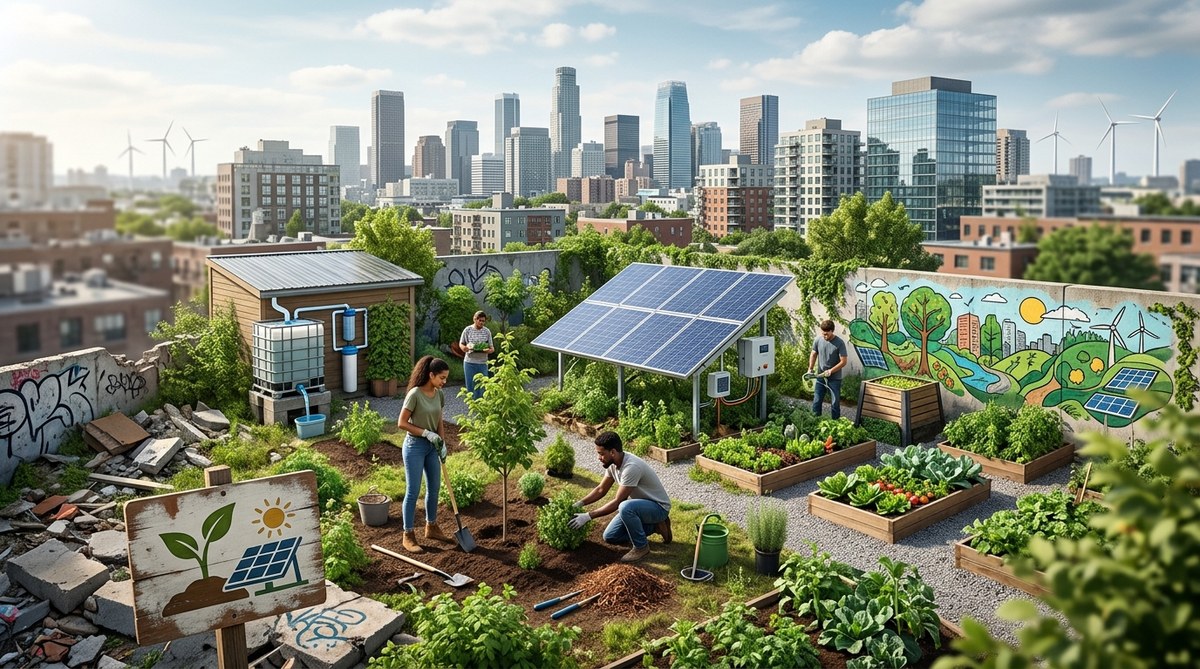
Across the United States, a quiet transformation is taking place on blocks that once felt forgotten. The vacant lot on your corner, the overgrown patch behind the old factory, the stretch of cracked concrete where a house used to stand: these spaces are no longer just eyesores. In 2026, they have become critical front lines in the fight against climate change. Cities from Detroit to Philadelphia are discovering that how we manage these empty parcels can determine whether a neighborhood survives the next heat wave, flood, or drought. It is a shift in perspective that turns a liability into a living, breathing asset.
Abandoned urban lots are not just neglected spaces. They are prime real estate for climate action. By converting them into rain gardens, community farms, and pocket forests, cities can reduce flooding, cool down heat islands, and capture carbon. This guide shows you exactly how these transformations work, what mistakes to avoid, and how your own city can join the movement in 2026.
Why vacant lots are a climate problem and an opportunity
Empty lots do more than lower property values. They actively make climate change worse in your neighborhood. Bare soil and pavement absorb heat during the day and release it at night, creating micro heat islands that can be 10 to 15 degrees hotter than surrounding areas. When heavy rain falls, these compacted lots cannot absorb water, so stormwater runs into overloaded sewers, causing basement backups and street flooding.
But here is the hopeful part: the same qualities that make a vacant lot a climate hazard also make it a perfect site for green infrastructure. The land is already available. There is no need to buy out homeowners or demolish occupied buildings. Cities just need the will to act.
“We realized that the land we were mowing every month was actively working against us. When we turned it into a rain garden, it started working for us.” — Maria Santos, Director of Urban Greening, Philadelphia Parks and Recreation
How cities are turning abandoned lots into climate solutions
The most successful programs treat vacant lots as infrastructure, not just landscaping. Here is a look at the specific strategies that are working across the country in 2026.
The rain garden revolution
In cities like Milwaukee and Baltimore, nonprofit groups and municipal crews are converting clusters of vacant lots into networked rain gardens. These are shallow, planted depressions that capture stormwater, filter pollutants, and let water soak slowly into the ground. One lot can absorb thousands of gallons per storm. When you connect several lots together, you create a sponge that protects entire blocks from flooding.
Pocket forests and urban woodlots
A growing number of cities are planting dense, native forests on abandoned parcels. These are not just a few trees in a row. They are layered ecosystems with canopy trees, understory shrubs, and ground cover. A well designed pocket forest can sequester carbon faster than a lawn, lower surrounding air temperatures by shading the ground, and provide habitat for birds and pollinators. Cleveland has planted over a dozen such forests since 2023, and the results are measurable.
Community food gardens
Vacant lots are also becoming sources of local food. In Detroit, the innovative strategies for achieving urban sustainability in the 21st century have turned hundreds of lots into community gardens. These gardens reduce the urban heat island effect, improve soil health, and cut down on food miles. They also build community resilience. When extreme weather disrupts supply chains, a neighborhood with its own food source is better prepared.
Cool pavement and permeable surfaces
Some lots are not suitable for deep planting because of buried utilities or contaminated soil. In those cases, cities are using permeable pavers and reflective surfaces. A lot covered in light colored, porous material does not heat up as much and allows rainwater to infiltrate. It is a low cost way to address why your city’s heat island effect is making climate change worse.
A numbered process for turning a vacant lot into a climate asset
If you are an urban planner or a community leader looking to start a project, here is a practical, step by step process that has worked in cities like Pittsburgh and New Orleans.
- Assess the site conditions. Test the soil for contaminants. Check drainage patterns. Note how much sunlight the lot gets. Talk to neighbors about what they want to see.
- Choose the right intervention. Match the site to the best use. A lot on a low lying block prone to flooding needs a rain garden. A lot on a south facing slope with good soil might be better for a pocket forest or food garden.
- Design for maintenance. This is the most overlooked step. A lot that requires constant weeding and watering will fail. Design with native plants that need less care. Plan for a neighborhood stewardship group or a city crew to handle seasonal tasks.
- Fund it through multiple sources. Use a mix of municipal stormwater fees, state grants, and federal climate resilience funds. Some cities also use community development block grants.
- Monitor and adapt. Track how the lot performs after heavy rain or during a heat wave. Adjust plantings and grading as needed. Share the data with the community.
Common mistakes and how to avoid them
Even well intentioned projects can backfire. Here is a table of the most frequent errors and the correct approaches.
| Mistake | Why it happens | Better approach |
|---|---|---|
| Planting too many trees without understory | Creates a monoculture that does not support biodiversity | Layer the planting with shrubs, grasses, and ground cover |
| Ignoring soil compaction | Water runs off instead of soaking in | Break up compacted soil with deep tilling or aeration before planting |
| Choosing non native ornamental species | Requires high water and fertilizer use | Select native species adapted to the local climate |
| Not involving the neighborhood | Residents feel the project is imposed on them | Hold block level meetings and let locals help design the space |
| Failing to plan for long term care | The lot becomes overgrown again within two years | Set up a maintenance fund and a volunteer schedule from day one |
What the data says about vacant lot greening
Researchers have been studying these projects for years, and the evidence is strong. A 2025 study from the University of Michigan found that converting just 10 percent of a city’s vacant lots to green infrastructure reduced localized flooding by 23 percent. Another study in Louisville showed that neighborhoods with greened lots had surface temperatures up to 8 degrees cooler during July heat waves.
These numbers matter because they translate into real savings. Less flooding means lower insurance costs. Cooler neighborhoods mean fewer heat related emergency room visits. And every lot that captures carbon helps the city meet its innovative strategies to reduce carbon footprints in urban areas.
The tools and technologies making it possible
Several innovations are helping cities scale up these efforts.
- GIS mapping tools that identify every vacant lot in a city and rank them by climate vulnerability.
- Low cost soil sensors that tell crews when a rain garden is saturated or needs dry weather watering.
- Modular planting systems that make it easier to install pocket forests on contaminated soil without digging up the entire lot.
- Community engagement apps that let residents report flooding or heat issues and suggest lots for greening.
These tools are part of the broader movement toward innovative green technologies transforming urban sustainability. They make it possible for a city of any size to act.
How you can get involved in 2026
You do not need to be a city planner to make a difference. Here are actions you can take starting today.
- Look up the vacant lot map for your city. Many municipalities now publish these online.
- Attend a community planning meeting for your ward or district. Ask about lot greening plans.
- Volunteer with a local nonprofit that does rain garden or tree planting projects.
- Talk to your neighbors about adopting a lot together. Even a small garden can help.
If you are a student or researcher, consider studying the long term carbon sequestration of pocket forests versus traditional lawns. The data is still thin, and your work could shape policy.
Why 2026 is the year to act
The window for meaningful climate adaptation is narrowing. Every year of delay means more extreme heat, more flooding, and more strain on city budgets. Vacant lots offer a rare chance to make progress without massive capital investment. The land is there. The methods are proven. What is missing in many cities is the public demand for change.
That is where you come in. When residents push for lot greening, city councils listen. When community groups show up with a plan, the city finds the funding. This is not a top down solution. It is a ground up movement.
The bigger picture: connecting lots to the larger climate network
A single greened lot is helpful. A network of greened lots across a city is transformative. These spaces can connect to each other through green corridors, linking parks, schoolyards, and creek beds. The result is a living infrastructure that manages stormwater, cools the air, and supports wildlife across whole neighborhoods.
This kind of connected thinking is central to transforming cities: how green infrastructure can reduce urban carbon footprints. It turns isolated projects into a cohesive system.
The hidden challenge: contaminated soil
One of the biggest barriers to lot greening is soil contamination. Many vacant lots sit on land that was once home to factories, auto shops, or dry cleaners. The soil may contain lead, arsenic, or petroleum residues. Planting food gardens on such lots is not safe without remediation.
But there are solutions. Some cities use raised beds with clean soil for food gardens. Others plant trees and shrubs that do not accumulate heavy metals in their edible parts. A few innovative programs use a technique called phytoremediation, where certain plants absorb contaminants from the soil over several growing seasons. It is not a fix, but it is a start.
If your city has many contaminated lots, do not give up. Focus on rain gardens and pocket forests that do not involve food production. Every bit of green space helps.
A look at three cities leading the way
Detroit, Michigan. With over 40,000 vacant lots, Detroit has become a laboratory for urban greening. The city’s Land Bank Authority works with community groups to turn lots into side lot expansions, gardens, and stormwater basins. The results have been dramatic. Some neighborhoods have seen a 30 percent reduction in reported flooding since 2022.
Philadelphia, Pennsylvania. The Philadelphia Water Department runs a program called Green City, Clean Waters that uses vacant lots as part of a citywide stormwater management system. They pay community groups to maintain rain gardens and provide free plants and training. It is a model for how communities can lead the way in climate change adaptation by 2026.
Tucson, Arizona. In a dry climate, vacant lots can become dust bowls that worsen air quality. Tucson is converting them into native desert gardens with mesquite trees and agaves. These lots use almost no water once established and provide shade that lowers cooling costs for nearby homes.
What to avoid when starting a project
Here is a bulleted list of pitfalls that can derail a lot greening effort.
- Starting without community buy in. If neighbors do not want it, the project will not survive.
- Choosing plants that need constant watering. In most US cities, water is becoming more expensive.
- Forgetting to check for underground utilities. You do not want to dig into a gas line.
- Making the lot too complex to maintain. Simple designs last longer.
- Ignoring the needs of people experiencing homelessness who may use the lot. Engage with social services first.
A simple framework for evaluating any vacant lot
When you look at a vacant lot in your city, ask these three questions.
- Does water pool here after a rain? If yes, it is a candidate for a rain garden.
- Is the soil clean enough for food? If yes, consider a community garden.
- Is the lot in a heat island zone? If yes, plant trees and shade structures.
These three questions will guide you toward the right intervention every time.
The role of policy and funding
None of this works without supportive policies. Some cities have passed ordinances that give property owners tax breaks for greening vacant lots. Others have created “land banks” that can acquire lots and hold them for green use. Federal programs like the Inflation Reduction Act and the Environmental Protection Agency’s Brownfields grants provide funding for assessment and cleanup.
If your city does not have these policies, advocate for them. Write to your city council member. Show up at budget hearings. Bring the data on flooding and heat reduction. It works.
How to measure success
Do not just count the number of lots greened. Measure what matters.
- How many gallons of stormwater did the lot capture this year?
- How much did the surrounding air temperature drop on the hottest day?
- How many pounds of vegetables did the community garden produce?
- How many volunteers participated in maintenance?
These metrics tell the real story. They also help you make the case for more funding.
The future of vacant lot greening
By 2030, many US cities plan to have 100 percent of their publicly owned vacant lots converted to green infrastructure. That is an ambitious goal, but it is achievable. The technology is there. The knowledge is there. What we need now is the will to scale up.
Private landowners are also getting involved. Some cities offer matching grants to homeowners who green their own empty side lots. Others require developers to include green space on any new construction. The trend is moving in the right direction.
Where your city fits in
Your city may already have a vacant lot greening program. Search for “vacant lot greening” plus the name of your city. If nothing comes up, that is an opportunity. You can be the person who starts the conversation.
Share this article with your local sustainability office. Send it to your neighborhood association. Post it on social media. The more people who understand that climate change urban vacant lots are connected, the faster things will change.
Turning a liability into legacy
The vacant lot on your street is not a symbol of decline. It is a plot of land waiting for a purpose. With the right plants, the right design, and the right community support, it can become a place that cools the block, soaks up the rain, and feeds the neighborhood. That is not just climate adaptation. That is a better way to live.
Start small. Pick one lot. Talk to your neighbors. Make a plan. The next time a heat wave hits or a storm rolls in, that lot will be working for you instead of against you.