
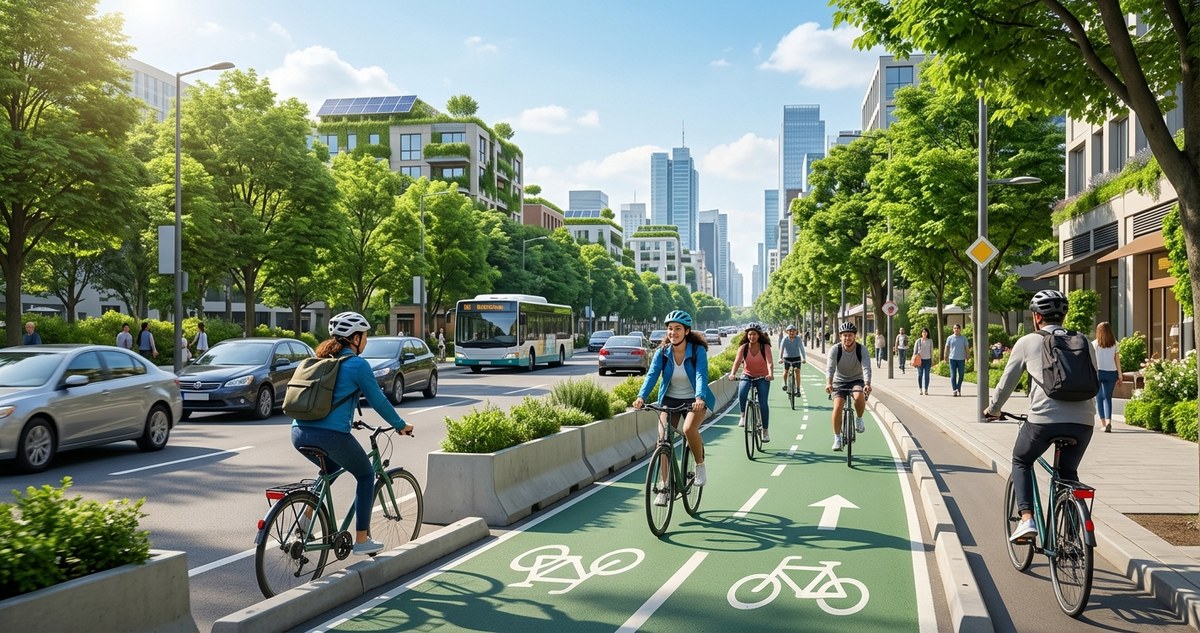
Picture this: a strip of asphalt painted green, separated from car traffic by a row of flex posts. It looks simple. It might even seem like an inconvenience to drivers who lose a lane. But that thin ribbon of pavement is one of the most effective climate tools your city has. And most of us are walking right past it without a second glance.
The truth is, bike lanes do far more than give cyclists a safe place to ride. They cut carbon emissions, reduce the urban heat island effect, lower air pollution, and reshape how we think about getting from point A to point B. In 2026, as cities across the United States face record heat waves and tightening emissions deadlines, the humble bike lane deserves a spot at the center of every climate action plan.
Bike lanes are a proven, low-cost climate solution that reduces transportation emissions, cools city streets, and improves public health. When cities build connected networks of protected bike lanes, they see measurable drops in car usage and CO2 output. Ignoring this tool means missing one of the easiest wins in the fight against climate change.
Why Your Car Habit Is the Real Problem
Transportation is the largest source of greenhouse gas emissions in the United States. According to the EPA, cars and trucks account for roughly 29% of total emissions. Most of those trips are short. Data from the National Household Travel Survey shows that nearly 40% of all car trips in the US are under two miles. That is a distance most people could bike in under 15 minutes.
The gap between what we drive and what we could bike is staggering. For every mile you pedal instead of drive, you save roughly one pound of CO2. If every American who lives within a 5 mile radius of their workplace swapped the car for a bike just twice a week, we would cut over 50 million metric tons of carbon pollution annually. That is the equivalent of taking 11 million cars off the road for good.
Bike lanes are the infrastructure that makes that swap possible. Without safe, protected routes, most people will not ride a bike to work or the grocery store. It is that simple. Build the lanes, and people use them. A 2023 study from Portland State University found that cities that added protected bike lanes saw cycling rates increase by 75% or more within two years.
The Cooling Effect Nobody Talks About
Here is a climate benefit that rarely makes the headlines. Asphalt and concrete absorb heat from the sun and release it slowly, creating the urban heat island effect. In cities like Phoenix, Los Angeles, and New York, temperatures can be 5 to 10 degrees higher than surrounding rural areas. That extra heat drives up air conditioning use, which drives up emissions, which drives up temperatures. It is a vicious cycle.
Bike lanes help break that cycle. When cities replace a car lane with a protected bike lane, they often remove a lane of heat absorbing asphalt. Some cities go further and use cool pavement materials or add greenery alongside the bike path. Even a single lane conversion can lower local surface temperatures by several degrees.
A study from the University of California found that neighborhoods with dense cycling networks had noticeably cooler microclimates than car dominant areas. Less asphalt means less heat retention. More bikes mean fewer exhaust pipes pumping hot air into the street. It is a small change that adds up across an entire city.
What Makes a Bike Lane a Climate Solution?
Not all bike lanes are created equal. A painted line on the side of a busy road does not do much to encourage ridership. A protected, physically separated lane does. Here is a breakdown of what works and what does not.
| Type of Bike Lane | Safety Level | Emissions Impact | Cost per Mile |
|---|---|---|---|
| Painted sharrow (shared lane) | Low | Minimal | Very low |
| Striped bike lane (no barrier) | Moderate | Low | Low |
| Protected bike lane (with barrier) | High | High | Moderate |
| Cycle track (fully separated) | Very high | Very high | High |
| Bike boulevard (low traffic street) | High | Moderate | Low |
The data is clear. Protected bike lanes and cycle tracks deliver the biggest climate benefits because they attract the most riders. A painted line on a 45 mph road will only appeal to the bravest cyclists. A protected lane with physical barriers, good lighting, and clear signage appeals to everyone else. That is where the emissions reductions come from.
Three Steps Your City Can Take Right Now
If you are a city planner, an advocate, or just a concerned resident, here is a practical roadmap for turning bike lanes into a real climate solution.
-
Audit your existing street grid for short trip potential. Identify neighborhoods, schools, grocery stores, and job centers that are within a 3 mile radius of each other. Map the most direct routes between them. Those are your priority corridors.
-
Build a pilot protected lane on one high priority corridor. Use temporary materials like plastic bollards and flexible posts to test the lane for six months. Measure ridership before and after. Measure car speeds and traffic volume. Share the data publicly.
-
Connect the dots into a network. A single bike lane is nice. A connected network of lanes is transformative. Prioritize linking existing lanes to close gaps. Focus on routes that lead to transit hubs, schools, and downtown employment centers.
Common Objections and Why They Fall Apart
Critics of bike lanes often raise the same arguments. Let us address them directly.
-
“Bike lanes cause traffic congestion.” Studies from cities like New York, San Francisco, and Seattle show that removing a car lane and adding a bike lane rarely increases overall travel times. In many cases, traffic actually flows better because fewer people drive. Induced demand works both ways. When driving becomes slightly less convenient, some people choose to bike, which reduces congestion for everyone else.
-
“Nobody uses them in winter or rain.” That is true for some people, but not everyone. Cities like Minneapolis, Montreal, and Copenhagen see strong year round cycling because they maintain their bike lanes in winter. Snow removal, heated pavement, and weather protected routes keep people riding. In the US, cities like Chicago and Denver are starting to copy that approach.
-
“They are too expensive.” Compared to road maintenance, highway expansion, or parking garages, bike lanes are a bargain. A mile of protected bike lane costs roughly $100,000 to $500,000. A single mile of urban highway costs $10 million or more. The return on investment for bike lanes in health savings, reduced emissions, and lower infrastructure costs is well documented.
“The most cost effective climate investment a city can make is building protected bike lanes. They pay for themselves in health benefits alone within a few years.” – Dr. Rebecca Sanders, urban transportation researcher at the University of California, Davis
How Bike Lanes Fit Into a Bigger Climate Picture
Bike lanes are not a silver bullet. They work best when combined with other climate strategies. Pair them with better public transit, congestion pricing, electric vehicle charging infrastructure, and green building codes, and you get a comprehensive urban climate plan.
For example, cities that build bike lanes near transit stations make it easier for people to bike to the train or bus instead of driving the whole way. That last mile connection is often the hardest part of using public transit. A bike lane solves it.
Bike lanes also support renewable energy goals indirectly. When fewer people drive, the grid faces less demand for electricity to power EV charging stations. That frees up renewable energy for other uses. It is a small ripple effect, but it matters.
If you want to see how other green infrastructure strategies can work alongside bike lanes, check out our guide on innovative strategies to reduce carbon footprints in urban areas. It covers cool roofs, green walls, and permeable pavements that complement cycling networks.
The Health Bonus You Get for Free
Climate solutions that also improve human health are rare. Bike lanes deliver both. Regular cycling reduces the risk of heart disease, stroke, diabetes, and certain cancers. It lowers stress and improves mental health. It also reduces air pollution exposure for everyone, because fewer cars mean less exhaust.
A 2025 study from the Lancet Planetary Health journal estimated that if US cities built out protected bike lane networks to cover 25% of major streets, the health benefits would save over 8,000 lives per year from improved air quality and increased physical activity. That is not a side effect. That is a core benefit.
What You Can Do Tomorrow
You do not need to be a city planner to make a difference. Here are actions you can take starting today.
- Ride your bike for one trip this week that you normally would drive. Pick a short errand. See how it feels.
- Write to your city council member or transportation department. Ask them to prioritize protected bike lanes in the next capital improvement plan.
- Join a local advocacy group. Organizations like the League of American Bicyclists and People for Bikes have local chapters in most major US cities.
- Share this article with a friend or neighbor who thinks bike lanes are just for cyclists. They are for everyone who breathes air.
For more on how cities are integrating these systems with renewable energy, read about innovative ways to integrate small-scale renewable energy into urban living. The overlap between clean energy and clean transportation is growing every year.
The Cost of Doing Nothing
Every year that a city delays building bike lanes, it locks in another year of car dependent infrastructure. That means more emissions, more heat, more asthma, and more traffic. The status quo is not neutral. It is actively working against climate goals.
Consider this. The city of Oslo, Norway, invested heavily in bike lanes and pedestrian infrastructure starting in 2015. By 2023, they had reduced transportation emissions by 35% and saw zero pedestrian or cyclist deaths for the first time in history. They did not invent new technology. They just prioritized people on bikes over people in cars.
US cities can do the same. Portland, Oregon, has cut its per capita transportation emissions by over 20% since 2005, largely through bike lane expansion and transit investment. Minneapolis has one of the highest bike commuting rates in the country thanks to its protected lane network and winter maintenance program. These are not European outliers. These are American cities that made a choice.
Your City’s Bike Lanes Are a Climate Solution You Should Not Ignore
The next time you see a bike lane, do not think of it as a nuisance for drivers. Think of it as a carbon reduction tool. A heat mitigation strategy. A public health intervention. A piece of the climate puzzle that is sitting right in front of us, ready to be used.
Building more bike lanes will not solve climate change by itself. But no single solution will. What bike lanes do is offer a high impact, low cost, immediately available option that cities can start implementing this year. No waiting for new technology. No massive capital budgets. Just paint, posts, and the will to prioritize people over cars.
If you are a city planner, start that pilot project. If you are a resident, make your voice heard. If you are someone who cares about the climate, get on a bike and ride. The infrastructure will follow the demand.
For a deeper look at how urban design choices like bike lanes connect to broader climate adaptation, see our piece on transforming cities with green infrastructure to reduce urban carbon footprints. The path to a cooler, cleaner, healthier city starts with a single lane.