
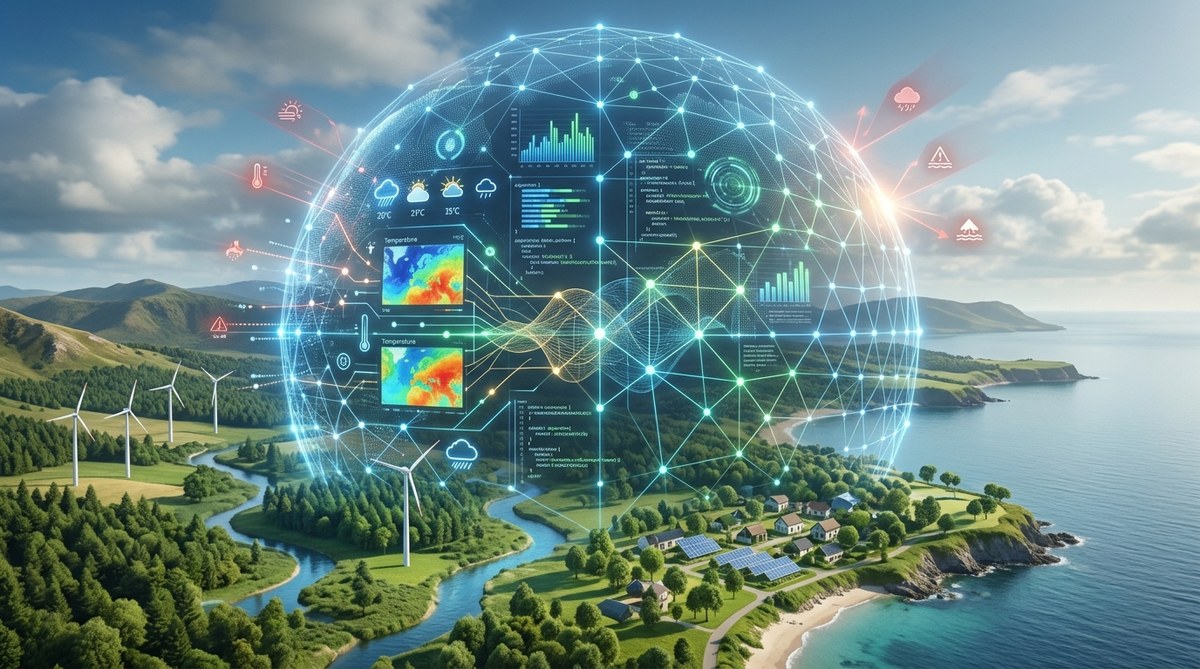
Picture this: a hurricane is brewing off the coast of Florida. In the past, forecasters might have had a day or two of clear warning. Today, an AI system ingests satellite data, ocean temperatures, and atmospheric pressure readings. Within hours, it predicts the storm’s exact path, intensity, and likely landfall zone. Emergency managers get an extra 72 hours to evacuate communities and pre position supplies. That is not science fiction. It is happening right now, in 2026.
Artificial intelligence is reshaping how we anticipate and respond to climate disasters. By analyzing vast datasets with machine learning, AI can detect patterns invisible to humans, issue earlier warnings, and optimize resource allocation. This article explains the core methods, real world applications, and ethical boundaries of using AI for climate resilience, helping professionals put these tools into practice.
How AI Learns to Predict Climate Disasters
Machine learning models thrive on data. For climate disasters, that data comes from satellites, weather stations, buoys, and historical records. The more data, the better the prediction. AI systems look for subtle correlations, like a specific sea surface temperature anomaly that preceded a major flood in Bangladesh five years ago.
Here are the main types of AI used in this field:
- Neural networks — model complex relationships between hundreds of climate variables.
- Random forests — handle missing data well and rank which factors matter most for a disaster.
- Convolutional neural networks (CNNs) — analyze satellite imagery to detect wildfires, storm clouds, or ice melt.
- Recurrent neural networks (RNNs) and LSTMs — excel at time series forecasting, like predicting rainfall patterns weeks ahead.
These models are trained on past events. A hurricane model learns from every Atlantic hurricane since 1980. A flood model studies river gauge data and rainfall records for decades. Once trained, the AI can look at current conditions and generate a risk score for the next few days or even weeks.
For disaster managers, this means moving from reactive response to proactive planning. Instead of waiting for a crisis, you can see a threat forming days or months in advance. That extra time is everything.
Turning Predictions into Prevention
Knowing a disaster is coming is only half the battle. The real value of AI lies in helping humans act. Here is a practical process that many agencies are now using in 2026:
-
Integrate diverse data sources. Combine satellite imagery, social media feeds, IoT sensor networks, and historical archives into a single platform. AI can clean and normalize this messy data automatically.
-
Train custom models for your region. Pre built models may not work for your local geography or hazards. Use transfer learning to adapt a global model to your area, using local data from the last five to ten years.
-
Set up real time monitoring and alerts. Deploy the AI model to run continuously. When it detects a pattern that matches a past disaster signature, it sends a push notification to emergency operations centers.
-
Simulate response scenarios. AI can run thousands of “what if” simulations in minutes. Should you evacuate Zone A or Zone B first? How many buses will you need? The AI crunches the logistics and suggests an optimal plan.
-
Communicate clearly with the public. Use AI generated natural language summaries to explain risks in plain English. Pair that with maps and visuals that show exactly which neighborhoods are in danger.
This numbered workflow is already being used by FEMA and several state emergency management agencies. It reduces decision time from hours to minutes.
What AI Can (and Can’t) Predict
No tool is perfect. AI has remarkable strengths, but also clear limits. The table below compares common techniques with their known limitations.
| AI Technique | What It Does Well | Where It Falls Short |
|---|---|---|
| Neural networks for hurricane track forecasting | Predicts path and intensity 3-7 days out with high accuracy | Struggles with rapid intensification events; uncertainty grows beyond day 7 |
| CNN for satellite imagery analysis | Detects wildfires, floods, and ice melt in near real time | Cannot predict the exact ignition point of a wildfire days in advance |
| LSTM for rainfall prediction | Forecasts precipitation patterns up to two weeks ahead | Performance drops in regions with sparse ground stations |
| Random forest for flood risk mapping | Identifies high risk zones based on topography and drainage | Does not account for human factors like levee failures or urban development changes |
“AI is not magic. It gives us time, but it cannot override physics or human error. Our job is to use that time wisely, to strengthen infrastructure and coordinate response before the storm hits.” — Dr. Elena Vasquez, Climate Data Scientist, NOAA
Understanding these boundaries helps teams set realistic expectations. Do not ask AI to predict a tornado touchdown three weeks early. Do ask it to flag conditions that historically preceded tornado outbreaks.
Real World Examples in 2026
In California, a machine learning system trained on satellite imagery and vegetation dryness now alerts fire departments about areas at extreme risk of ignition. In the past two years, it has helped contain three major wildfires before they spread beyond a few hundred acres.
In the Gulf Coast, an AI model combines wind speed, storm surge, and population density data to issue targeted evacuation orders for specific zip codes. That level of granularity means fewer people are evacuated unnecessarily, saving money and reducing panic.
Meanwhile, in the Northeast, flood prediction systems use river gauge data combined with NOAA rainfall forecasts to predict which basements and streets will be submerged. Cities like Hoboken and New York now use these alerts to deploy portable barriers and pumps.
These examples show that AI climate disaster prediction prevention is not theoretical. It is saving lives and property today.
Ethical Considerations for AI in Disaster Management
Any powerful tool comes with responsibility. Here are the main concerns researchers and policymakers must address:
- Data bias. If training data lacks records from low income communities, the AI might under warn those areas. Ensure your dataset covers all demographics and regions equally.
- Privacy. Real time location data from phones can help track evacuations, but it also raises surveillance risks. Use anonymized, aggregated data whenever possible.
- Overreliance. Do not let AI replace human judgment. Models can hallucinate patterns that aren’t real. Always have a meteorologist or disaster expert in the loop.
- Equity. Early warning systems must reach everyone, including non English speakers and people without smartphones. Pair AI alerts with radio broadcasts and community outreach.
For a deeper look at how climate change is already reshaping preparation efforts, see our guide on how climate change is redefining disaster preparedness in the US. And if you are a community leader, you might find how communities can lead the way in climate change adaptation by 2026 helpful for local planning.
A New Era of Climate Resilience
AI will never stop hurricanes or prevent a drought. But it can give us the critical hours and days we need to protect the most vulnerable. In 2026, the technology has matured enough for widespread adoption. The barriers are no longer technical; they are organizational and financial.
For researchers, the call is to continue refining models, especially for rare but catastrophic events. For policymakers, the priority is funding data infrastructure and training for local agencies. For disaster management professionals, the time to start piloting AI tools is now.
We also recommend reading why 2026 is the pivotal year for climate action in the United States to understand the broader policy context. And for practical steps in urban areas, check out our piece on innovative strategies to reduce carbon footprints in urban areas. Every reduction in emissions makes the disasters we face less intense.
Start small. Pick one hazard that affects your region. Get the data. Train a simple model. Test it against last year’s events. Refine. Then expand. The AI is ready. Are you?