
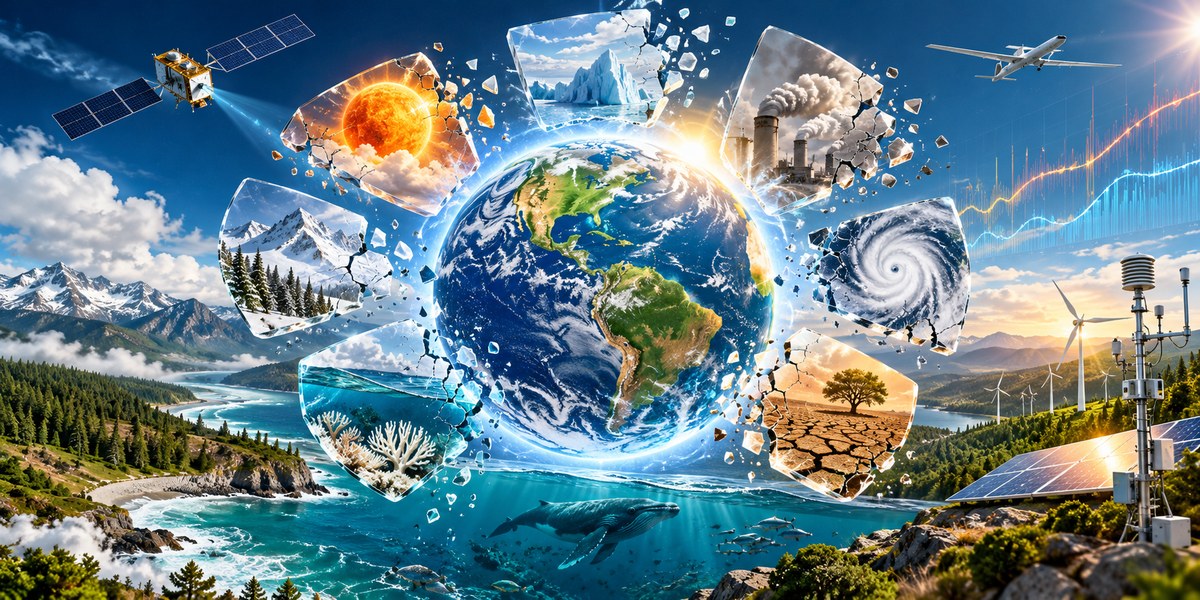
You have probably heard someone say that climate change is a hoax, or that the planet has stopped warming. These claims spread fast on social media and in casual conversations. But the data tells a different story. In 2026, the evidence for human-caused climate change is stronger than ever. Let us walk through seven of the most persistent climate change myths and see what the science actually says.
Climate misinformation often sounds plausible but falls apart under peer-reviewed scrutiny. From satellite temperature records to ice core data, scientists have repeatedly shown that the planet is warming due to human activity. This guide gives you the facts to counter seven common myths with confidence. You will learn the real story behind each claim and where to find trustworthy sources.
The “Climate Change Is a Natural Cycle” Myth
One of the oldest myths claims that the current warming is just part of Earth’s natural cycle. It is true that the planet has gone through ice ages and warm periods. But the speed of today’s warming is unprecedented. Natural cycles happen over tens of thousands of years. We have seen more warming in the last 150 years than in the previous 2,000. The main driver is the rapid increase in greenhouse gases from burning fossil fuels.
Scientists at NASA and NOAA track these changes with satellites, ocean buoys, and weather stations. They all show the same trend. If you want to see how renewable energy is already replacing fossil fuels, check out innovative strategies to reduce carbon footprints in urban areas.
The “Global Warming Stopped in 1998” Myth
This myth relies on cherry picking a single year. 1998 was an extremely hot El Niño year. If you start a graph there, it looks like the temperature flattens for a while. But that is a statistical trick. The full temperature record shows a clear upward climb. Every year since 2014 has been hotter than 1998. The 2010s were the hottest decade on record, and the 2020s are on track to beat that.
A better way to look at the data is to use a 10 year rolling average. That smooths out natural variability and shows the real trend. When you do that, the warming is obvious.
The “Carbon Dioxide Is Plant Food” Myth
Plants do need CO2 to grow. That is basic biology. But the myth twists this fact into a claim that more CO2 is good for the planet. The reality is more complicated. While some plants grow faster with extra CO2, the quality of that growth declines. Crops like wheat and rice lose protein content. Weeds and invasive species often benefit more than food crops. Meanwhile, the negative effects of climate change like heat waves, droughts, and floods hurt agriculture far more.
For a deeper look at how farmers are adapting, read how climate change is driving innovation in agriculture.
The “Scientists Disagree on Climate Change” Myth
This myth is one of the most damaging. It creates a false sense of debate. In reality, the consensus among climate scientists is overwhelming. Multiple surveys show that 97 to 99 percent of actively publishing climate scientists agree that humans are causing global warming. Every major scientific academy in the world endorses this view.
If you encounter someone who says “the science is not settled,” you can point them to the IPCC reports. These are written by thousands of scientists and reviewed by governments. The conclusions have been consistent for decades.
The “It’s Too Late to Do Anything” Myth
Some people swing from denial to despair. They argue that we have already passed the point of no return. This is not supported by science. While we have already caused some warming, every fraction of a degree we prevent matters. The difference between 1.5°C and 2°C of warming means less sea level rise, fewer heat waves, and less species loss.
Technology is advancing faster than many realize. Solar and wind power are now cheaper than coal in most places. Battery storage is improving. Electric vehicles are becoming mainstream. For a look at what is coming next, see the future of renewable energy and its impact on climate resilience.
The “Climate Models Are Unreliable” Myth
Climate models have been remarkably accurate. Early models from the 1970s and 1980s predicted the warming we are seeing today. They get better with every update. Skeptics often point to short term differences between models and observations, but those are minor compared to the long term accuracy.
Here is a simple table showing how different predictions have held up:
| Prediction | Year Made | Actual Outcome | Accuracy |
|---|---|---|---|
| CO2 levels would reach 410 ppm by 2020 | 2000 | 414 ppm | Very close |
| Global temperature would rise 0.3°C per decade | 1990 | 0.2°C per decade | Slightly conservative |
| Arctic sea ice would decline sharply | 2005 | Confirmed | Accurate |
| Extreme weather events would increase | 2007 | Confirmed | Accurate |
The “Technology Will Fix Everything Without Sacrifice” Myth
This is a comforting idea, but it is not realistic. Technology is a powerful tool, but it cannot replace the need to reduce emissions. Carbon capture, geoengineering, and other futuristic solutions are still in early stages. They are expensive and unproven at scale. We cannot rely on them to do all the work.
What works is a combination of strategies. Here is a list of actions that have the biggest impact:
- Transitioning to renewable energy sources
- Improving energy efficiency in buildings and industry
- Electrifying transportation
- Reducing food waste and shifting to plant rich diets
- Protecting and restoring forests and wetlands
For a practical guide on what you can do at home, see how to prepare your home for climate change without breaking the bank.
How to Fact-Check a Climate Claim in 3 Steps
When you hear a new climate myth, you can fact check it yourself. Here is a simple process:
- Identify the source. Is it a peer reviewed study, a news article, or a social media post? Look for the original data.
- Check the date. Outdated information is common. Make sure the claim uses recent data.
- Search for a consensus. See what NASA, NOAA, the IPCC, or major universities say. If the claim contradicts the consensus, it is likely wrong.
“The most important thing you can do is to rely on scientific institutions rather than anonymous social media accounts. The evidence is public and transparent.” — Dr. Katherine Hayhoe, climate scientist
The Hidden Cost of Air Conditioning
Many myths about climate change focus on abstract data. But one concrete example is the way we cool our homes. Air conditioning is a lifesaver during heat waves, but it also contributes to the problem. The refrigerants used in many AC units are potent greenhouse gases. The electricity they consume often comes from fossil fuels. This creates a feedback loop: the hotter it gets, the more we use AC, which makes the planet hotter.
For more on this topic, read the hidden cost of air conditioning: how cooling our homes is warming the planet.
What Real Climate Action Looks Like in 2026
The conversation around climate change myths debunked is not just about winning arguments. It is about making informed decisions. In 2026, the United States is seeing more extreme weather, from wildfires in the West to hurricanes in the Southeast. Insurance companies are raising rates or leaving coastal states. Farmers are adapting to new growing seasons. Schools are updating their curricula.
All of these changes are connected to climate change. Understanding the science helps us prepare and adapt. It also helps us support policies that actually work.
If you want to see how communities are stepping up, check out how communities can lead the way in climate change adaptation by 2026.
A Clearer Path Forward
Climate change myths debunked by science give us a solid foundation for action. When we strip away the misinformation, the path forward becomes clearer. We know what the problem is. We know what causes it. And we know what solutions work. The question is whether we will choose to implement them at the scale needed.
Every conversation matters. Every fact you share helps push back against the noise. The next time someone repeats one of these myths, you will have the evidence ready. Use it kindly and clearly. That is how real change starts.