
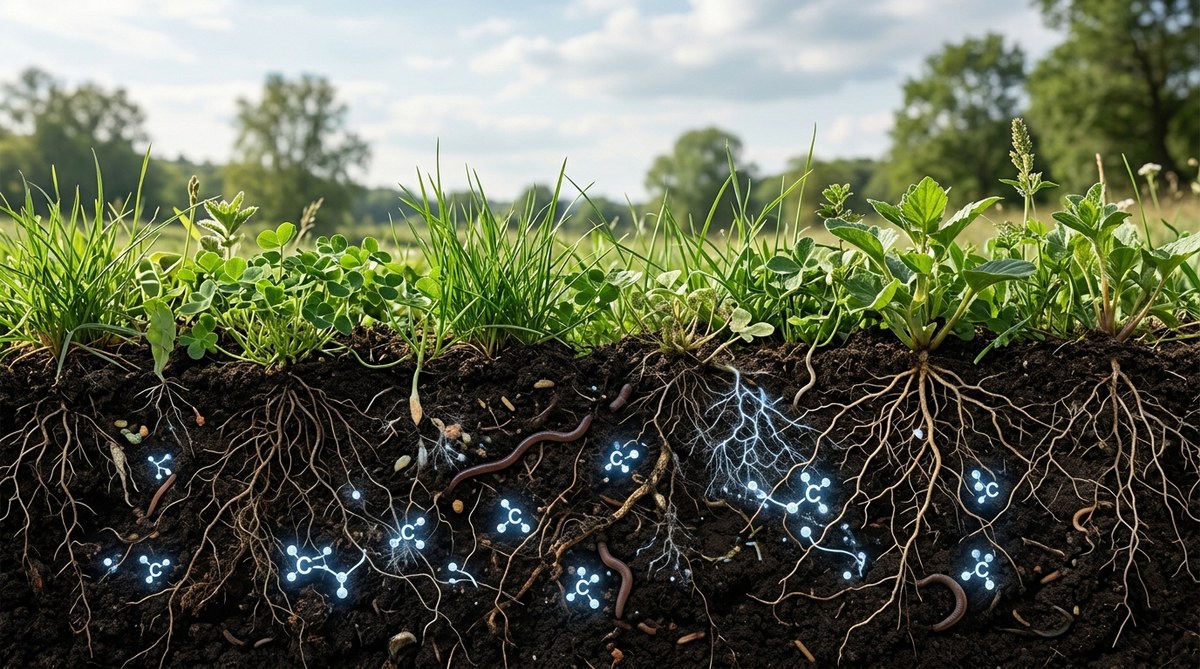
For years, the climate conversation has focused on what we can see. Solar panels on rooftops. Wind turbines on ridgelines. Electric cars in traffic. But there is a quieter, more grounded climate hero beneath our feet. The soil. Healthy soil is not just a medium for growing food. It is one of the planet’s most effective tools for pulling carbon dioxide out of the atmosphere. And we are only beginning to understand how powerful it can be. When we talk about soil health carbon storage, we are talking about a natural process that has been working for millennia. The challenge is that modern farming has broken that process. The good news is that we can fix it.
Soil health carbon storage is a proven, natural climate solution that can sequester billions of tons of CO2 annually. By shifting to regenerative practices like no-till farming, cover cropping, and managed grazing, we can restore degraded soils, improve water retention, and store carbon for centuries. It is one of the most cost-effective tools we have for climate mitigation.
The Hidden Engine Beneath Our Feet
Think of soil as a living bank account. Plants pull carbon dioxide from the air during photosynthesis. They convert that carbon into sugars and send it down through their roots. In healthy soil, microbes, fungi, and earthworms process that carbon and store it in stable forms. This is the essence of soil health carbon storage. A single teaspoon of healthy soil can contain more living organisms than there are people on Earth. Those organisms are the workers that build soil structure and lock carbon away.
But here is the problem. Conventional farming practices like deep tilling, heavy chemical use, and leaving soil bare between growing seasons have turned this system upside down. When you plow a field, you expose stored carbon to the air. It oxidizes and becomes CO2 again. The United Nations estimates that agricultural soils have lost 50 to 70 percent of their original carbon stocks. That carbon is now in the atmosphere, contributing to climate change. The good news is that we can reverse this trend.
How Soil Stores Carbon: A Simple Breakdown
Understanding the mechanics helps us see why soil health carbon storage is so effective. Here is how the process works, step by step:
-
Photosynthesis captures carbon. Plants absorb CO2 from the air and use sunlight to turn it into organic compounds. This is the entry point for carbon into the soil system.
-
Roots transfer carbon underground. Plants send up to 40 percent of the carbon they capture down into the soil through their root systems. This feeds a vast network of microbes and fungi.
-
Microbes stabilize the carbon. Soil organisms consume root exudates and plant matter. They transform it into humus and stable organic matter that can remain in the soil for decades or even centuries.
-
Soil structure protects the carbon. Aggregates form around organic matter, physically shielding it from decomposition. This is why undisturbed soils hold carbon much longer than tilled soils.
-
Continuous plant cover maintains the cycle. When soil is always covered with living plants or crop residue, the carbon pump keeps running. Bare soil stops the process and releases stored carbon.
Common Mistakes That Undermine Carbon Storage
Even well-intentioned land managers sometimes make errors that reduce the effectiveness of soil health carbon storage. The table below outlines the most common mistakes and the regenerative solutions that work better.
| Common Mistake | Why It Hurts Carbon Storage | Better Approach |
|---|---|---|
| Deep tilling or plowing | Exposes organic matter to oxygen, causing rapid oxidation of stored carbon | Switch to no-till or strip-till methods that disturb soil minimally |
| Leaving soil bare after harvest | No plants means no carbon input; bare soil erodes and releases carbon | Plant cover crops like rye, clover, or buckwheat immediately after harvest |
| Overusing synthetic nitrogen fertilizers | Feeds plants but suppresses soil fungi and reduces carbon retention | Use compost, manure, or biological inoculants to feed the soil food web |
| Continuous monocropping | Reduces root diversity and microbial diversity, lowering carbon inputs | Rotate crops with diverse species including deep-rooted perennials |
| Overgrazing or mismanaged livestock | Compacts soil, kills plant roots, and reduces organic matter return | Implement rotational grazing with adequate recovery periods |
Practical Steps to Boost Soil Health Carbon Storage
If you manage land, whether it is a farm, a ranch, or a community garden, you can take action today. These practices are backed by decades of research and are being adopted across the United States by forward-thinking producers.
- Adopt no-till or reduced-till systems. Each time you disturb the soil, you lose carbon. No-till farming can increase soil organic matter by 0.1 to 0.2 percent per year, which adds up to significant carbon storage over a decade.
- Plant cover crops every season. Cover crops protect the soil, feed microbes, and add biomass. Species like cereal rye, hairy vetch, and daikon radish are excellent choices for different regions.
- Integrate livestock with rotational grazing. Animals can be a tool for building soil. When managed correctly, their manure adds organic matter and their grazing stimulates root growth. The key is moving them frequently and allowing long recovery periods.
- Use compost and organic amendments. Applying compost adds stable carbon directly to the soil. It also feeds the microbial community that builds soil structure.
- Minimize synthetic inputs. Reducing tillage and chemical use allows the natural soil food web to thrive. Healthier biology means more carbon is retained.
“Soil health is not a single practice. It is a shift in mindset. You stop treating the soil as a sterile medium and start treating it as a living ecosystem. When you do that, carbon storage happens as a byproduct of good management.” Dr. Christine Jones, soil ecologist and founder of the Carbon Coalition.
The Policy and Research Landscape in 2026
Interest in soil health carbon storage has grown dramatically in recent years. The United States Department of Agriculture has invested billions through programs like the Environmental Quality Incentives Program and the Conservation Stewardship Program. These programs pay farmers to adopt practices that build soil health and store carbon. Several states, including California, New York, and Illinois, have also launched their own soil health initiatives.
Research is catching up too. Long-term studies at the Rodale Institute show that regenerative organic systems can store more carbon than conventional systems. New measurement technologies, including satellite imaging and soil spectroscopy, make it easier to verify carbon gains. This is critical for carbon credit markets, which require accurate data to function. If you are interested in how these technologies fit into broader climate efforts, check out our article on how innovative technologies are transforming climate change mitigation.
Why Soil Health Carbon Storage Matters More Than You Think
Here is a number that puts things in perspective. The world’s soils hold about 2,500 gigatons of carbon. That is roughly three times the amount of carbon in the atmosphere. If we could increase soil carbon by just 0.4 percent per year on agricultural lands, we would offset about 30 percent of global greenhouse gas emissions. This is not a pipe dream. It is a realistic target that scientists call the “4 per 1000” initiative.
But the benefits go beyond carbon. Soils with high organic matter hold more water, which means they are more resilient to both droughts and floods. They produce healthier crops with fewer inputs. They support more biodiversity. In other words, soil health carbon storage is a climate solution that also helps us adapt to the changes already underway. For a broader look at how communities are preparing for these shifts, see our guide on how communities can lead the way in climate change adaptation by 2026.
A Path Forward for Every Stakeholder
Different groups have different roles to play in scaling up soil health carbon storage.
For farmers and ranchers, the first step is to start small. Pick one field and try no-till or cover crops. See what happens to your soil. Many farmers report lower input costs and better yields after a few years of regenerative practices.
For policymakers and advocates, the focus should be on removing barriers. That means funding research, expanding technical assistance, and creating carbon markets that reward real carbon gains. It also means educating the public about why soil matters.
For consumers and concerned citizens, your choices matter. Buying from farms that use regenerative practices sends a signal to the market. Supporting policies that fund soil health programs adds political pressure. And simply talking about soil health carbon storage with your friends and family helps normalize the idea.
The Ground Beneath Our Future
We often look for complex technological fixes for climate change. But one of the most powerful solutions is right under our noses. Soil health carbon storage is natural, proven, and scalable. It does not require expensive infrastructure or exotic materials. It requires a change in how we treat the land. That change is already happening on farms across the country. The question is whether we can accelerate it fast enough.
Every time you see a field with green cover in the winter, or a pasture with tall grasses and healthy animals, you are looking at carbon being pulled from the air. You are looking at a climate solution at work. The next time you walk on a patch of healthy soil, remember that you are standing on one of the most powerful tools we have for creating a stable climate. And you can be part of making that tool stronger.
Start by learning more. Talk to a local farmer about their soil health practices. Support organizations that advocate for regenerative agriculture. And consider how your own yard or garden can become a small carbon sink. The soil beneath your feet is waiting. All it needs is a chance to do its job.