
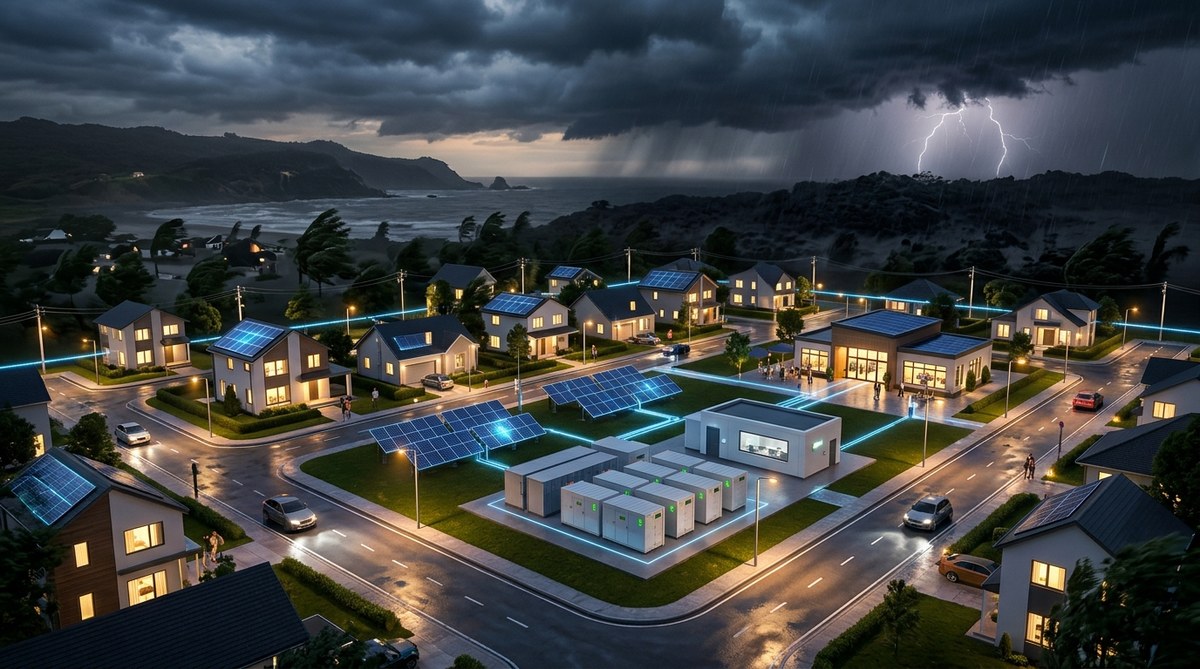
When a hurricane knocks out power for weeks, or a wildfire triggers public safety shutoffs, the grid goes dark. But some neighborhoods stay lit. They have a secret weapon: a microgrid. These small scale, self-contained energy systems can disconnect from the main grid and keep running on their own. They are not a futuristic concept anymore. In 2026, microgrids are a practical tool for surviving climate disasters.
Microgrids provide a lifeline during climate disasters by keeping power on when the main grid fails. They combine solar panels, battery storage, and smart controls to serve a single building or an entire neighborhood. For homeowners and planners, they offer energy independence, lower carbon footprints, and proven resilience against extreme weather events.
What Exactly Is a Microgrid?
Think of a microgrid as a tiny, independent power grid. It generates its own electricity, usually from solar panels or wind turbines. It stores that energy in batteries. And it can run all by itself, separate from the big utility grid.
This ability to “island” is what makes microgrids so valuable during climate disasters. When the main grid goes down, a microgrid automatically disconnects. It keeps power flowing to the homes, businesses, or critical facilities it serves. No flickering lights. No panic about losing food in the fridge.
Some microgrids serve a single building, like a fire station or a community center. Others link several homes together. The most ambitious ones power entire neighborhoods. They are not one size fits all. But they all share the same core goal: keep the lights on when the world outside goes dark.
Why the Main Grid Fails During Climate Disasters
The traditional power grid is a centralized system. Giant power plants send electricity hundreds of miles through transmission lines. This system works great on a sunny Tuesday. But it is vulnerable to extreme weather.
Hurricanes snap power poles like twigs. Wildfires force utilities to shut down lines to prevent sparks. Heat waves overload transformers. Ice storms bring down entire sections of the grid. In 2026, these events are happening more often and with more intensity.
The result is widespread, prolonged blackouts. A 2023 study found that weather related power outages in the US have increased by 78% since 2000. A single outage can leave millions without power for days or weeks. For vulnerable populations, that can be life threatening.
This is where microgrids shine. They do not rely on those long, exposed transmission lines. They generate power right where it is used. They are built for resilience, not just efficiency.
How Microgrids Keep Power Flowing Through a Crisis
Let’s look at how a neighborhood microgrid actually works during a disaster. The process is elegant and automatic.
- The grid goes down. A hurricane takes out the main power lines feeding your area. The utility grid fails.
- The microgrid senses the outage. Smart controllers detect the loss of power from the utility. Within milliseconds, the microgrid disconnects from the main grid using a device called a “point of common coupling.” This protects the system and prevents backfeeding.
- Local generation kicks in. Solar panels on rooftops or a shared community solar array start powering the microgrid. If it is night or cloudy, battery storage takes over. Some microgrids also use small natural gas generators or wind turbines as backup.
- Power is distributed intelligently. The microgrid’s software prioritizes critical loads. Maybe it keeps the community center running as a cooling center. It ensures the water pump stays on. It might ration power to individual homes to stretch the battery supply.
- The grid comes back online. Once the utility restores power, the microgrid reconnects automatically. It goes back to its normal mode of operation.
This whole process happens without anyone flicking a switch. The neighborhood never notices the blackout.
The Benefits Go Beyond Disaster Survival
Microgrids are not just for emergencies. They offer real, everyday advantages that make them a smart investment.
- Lower energy costs. A microgrid lets you generate your own power during peak hours when electricity is expensive. You can store solar energy in batteries and use it at night. Many microgrids pay for themselves over time.
- Cleaner energy. Most microgrids run on renewable sources like solar and wind. This directly reduces carbon emissions. For environmentally conscious homeowners, this is a major draw.
- Grid support. When the main grid is stressed, microgrids can send power back to help prevent blackouts. Utilities are starting to pay for this service.
- Community resilience. A neighborhood with a microgrid becomes a safe haven during disasters. Neighbors can charge phones, refrigerate medicine, and run medical devices. This strengthens the entire community.
Comparing Microgrids to Backup Generators
Many people think a diesel generator is enough. But microgrids are a different class of solution. Here is how they stack up.
| Feature | Diesel Generator | Microgrid (Solar + Battery) |
|---|---|---|
| Fuel source | Diesel (must be stored and delivered) | Sunlight (free and abundant) |
| Runtime during outage | Limited to fuel supply | Indefinite with solar charging |
| Noise | Loud, constant noise | Silent operation |
| Emissions | High CO2 and particulate pollution | Zero emissions |
| Maintenance | Regular oil changes, fuel stabilizer | Low maintenance, no moving parts |
| Automation | Manual start and fuel management | Fully automatic |
| Cost over 10 years | High fuel and maintenance costs | Lower total cost after incentives |
For a homeowner or planner looking at long term resilience, the microgrid is the clear winner. It is cleaner, quieter, and more reliable.
A Practical Guide for Starting a Neighborhood Microgrid
You do not need to be an engineer to make this happen. Communities across the US are building microgrids right now. Here is a step by step process for getting started.
- Assess your community’s needs. Talk to your neighbors. What are the critical loads? Who needs medical equipment? What buildings could serve as emergency hubs? This will define the size and scope of your microgrid.
- Find a partner. Look for a local solar installer or energy consultant who has experience with microgrids. Many utilities also offer programs for community microgrids. Check with your city planning department.
- Secure funding. This is the biggest hurdle. But there are options. Federal tax credits for solar and battery storage are available through 2032. The Inflation Reduction Act offers direct pay incentives. Some states have grant programs for community resilience. Your local government may also have disaster preparedness funds.
- Design the system. Work with your partner to size the solar array and battery storage. Decide which homes and buildings will be connected. Plan for the smart controller and islanding equipment.
- Get permits and approvals. This involves your local building department and your utility. The utility needs to approve the interconnection agreement. This step can take time, so start early.
- Install and test. The physical installation is similar to a standard solar project, plus the battery and controls. Once installed, the system needs to be tested. Simulate a grid outage to make sure everything works.
- Educate the community. Hold a meeting for all participants. Explain how the microgrid works, what to expect during an outage, and how to conserve power if needed.
“A microgrid is not a purchase, it is a partnership. The technology is proven. The real work is building the community agreement and finding the right financing. Start with a small group of committed neighbors and grow from there.” – Maria Santos, Community Energy Director, Resilient Neighborhoods Project
Common Mistakes to Avoid
Building a microgrid is rewarding, but there are pitfalls. Here are the most common ones, and how to avoid them.
| Mistake | Why It Hurts | The Fix |
|---|---|---|
| Underestimating battery size | The system runs out of power during a multi day outage | Model your worst case scenario and add a 20% buffer |
| Ignoring utility interconnection rules | The utility denies the project or charges high fees | Talk to the utility early and hire an experienced engineer |
| Forgetting about maintenance | Batteries degrade, software needs updates | Create a maintenance plan and a small annual budget |
| Not getting community buy in | Neighbors feel left out or suspicious | Hold open meetings and make participation voluntary |
| Choosing the wrong partner | Inexperienced installers can botch the project | Check references and ask for microgrid specific experience |
The Role of Local Government Planners
If you are a city planner or a local government official, you have a unique opportunity. You can lead the way on microgrid adoption. Start by identifying critical facilities in your city: hospitals, fire stations, water treatment plants, emergency shelters. These are the perfect candidates for a microgrid.
You can also create zoning and permitting pathways that make microgrids easier to build. Some cities offer density bonuses or expedited permits for projects that include a microgrid. Others have created “resilience hubs” in underserved neighborhoods, pairing microgrids with community services.
Funding is available. The Department of Energy’s Grid Resilience State and Tribal Formula Grants program provides billions for projects like this. In 2026, there is more federal money for community resilience than ever before. Your job is to go after it.
For more on how cities are adapting to new climate realities, check out our guide on how climate change is forcing US cities to rethink zoning laws in 2026.
What Homeowners Can Do Right Now
You do not need to wait for a neighborhood project. You can start building your own personal resilience today.
If you own a home, consider installing solar panels paired with a battery. This gives you a mini microgrid for your house. During an outage, you can power your refrigerator, lights, and internet. With the right equipment, you can even run your well pump or a window AC unit.
Look for the “islanding” capability when you shop for a solar battery system. Not all batteries can do this. Make sure your installer configures the system to provide backup power during an outage. This is often called “whole home backup” or “critical loads panel.”
The upfront cost can be high, but federal tax credits and state rebates cut the price by 30% or more. Many installers offer financing. And the peace of mind is priceless.
Interested in a deeper look at the technology? Read our article on harnessing solar power innovations for a sustainable future.
Why 2026 Is the Year to Act
The climate is not waiting. In 2026, we are seeing more billion dollar disasters than ever before. Hurricane seasons are longer. Wildfire seasons are starting earlier. Heat waves are breaking records year after year.
The old approach of building a bigger, stronger central grid is not enough. We need a distributed system. We need power that can survive the storm, not just recover after it.
Microgrids are that solution. They are proven. They are affordable. And they are ready right now. The question is not whether microgrids work. The question is whether we are willing to build them.
Your Neighborhood Can Be a Powerhouse
Imagine a future where a hurricane hits, and your street never loses power. The community center stays open. The water keeps running. The kids can still do their homework. That future is not a dream. It is a design choice.
Start the conversation. Talk to your neighbors. Call your city council member. Get a quote from a local solar installer. The path to resilience begins with a single step.
If you want to learn more about how entire communities are leading the way, read our piece on how communities can lead the way in climate change adaptation by 2026. The tools are in your hands. The only thing missing is the will to use them.