
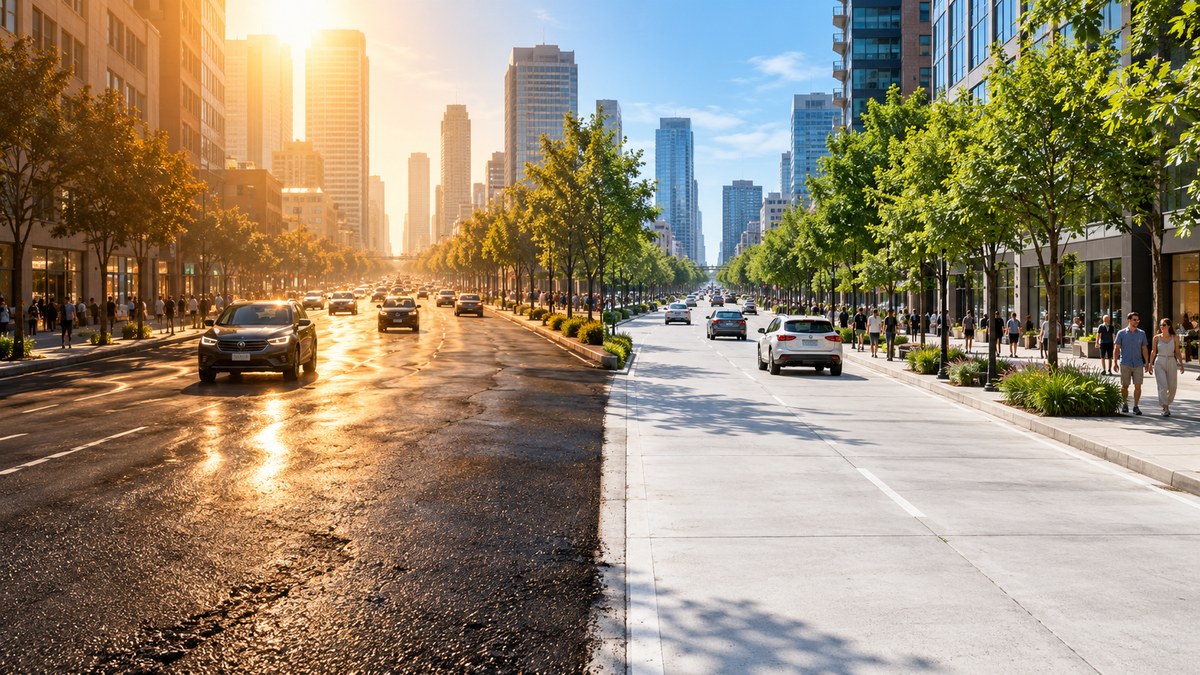
Your city’s streets, parking lots, and sidewalks might be working against the climate. On a hot summer afternoon in Phoenix or Atlanta, conventional dark pavement can reach 150 degrees Fahrenheit. That heat does not just disappear. It radiates back into the neighborhood, raising air temperatures and forcing air conditioners to run harder. This extra energy demand often comes from fossil fuel power plants, which pump more carbon into the atmosphere. The cycle feeds itself. Hotter cities mean more emissions, and more emissions mean hotter cities. But there is a growing solution that breaks that loop: cool pavements.
Standard dark pavements absorb up to 95 percent of sunlight, turning cities into heat islands that amplify climate change. Cool pavements use reflective materials, lighter colors, or porous structures to lower surface temperatures by 30 to 60 degrees. This reduces energy use, cuts carbon emissions, and helps communities stay safer during heat waves.
Why Standard Pavement Is a Climate Problem
Most roads and parking lots in the United States are made with asphalt or dark concrete. These materials are great at absorbing solar radiation. They trap heat during the day and release it slowly at night. This is the urban heat island effect in action.
The link to climate change is direct. When a city gets hotter, people use more air conditioning. More electricity consumption often means more natural gas or coal burned at power plants. A study from the Lawrence Berkeley National Laboratory found that the heat island effect can increase a city’s peak electricity demand by 10 to 15 percent. That extra demand leads to higher carbon emissions.
But the problem goes beyond energy bills. Hot pavements also:
- Increase ground-level ozone formation, worsening air quality
- Raise the risk of heat-related illness during extreme weather events
- Make nighttime temperatures stay uncomfortably high, disrupting sleep and recovery
- Accelerate the deterioration of the pavement itself, leading to more frequent repaving and more material waste
In 2026, with record heat waves hitting cities from Chicago to Miami, the connection between pavement and climate can no longer be ignored.
What Are Cool Pavements?
Cool pavements are a category of paving materials designed to reflect more sunlight and stay cooler than standard options. They fall into three main types.
| Type | How It Works | Surface Temperature Reduction | Best Use Case |
|---|---|---|---|
| Reflective coatings | Light-colored sealants or paints applied over existing asphalt | 30 to 60 degrees | Parking lots, residential streets |
| Porous or permeable pavement | Open structure allows water to evaporate, carrying heat away | 20 to 40 degrees | Sidewalks, low-traffic roads, driveways |
| Light-colored aggregate | Light stones or chips mixed into the asphalt binder | 25 to 50 degrees | Highways, commercial areas |
Each approach has trade-offs. Reflective coatings can be reapplied every few years. Porous pavements require regular cleaning to prevent clogging. But the climate benefits are consistent. When a city switches to cool pavements, it reduces the amount of heat stored in the built environment. This lowers ambient air temperatures and cuts the energy needed for cooling.
How Cool Pavements Directly Reduce Climate Emissions
The most direct way cool pavements fight climate change is by reducing electricity demand. Here is a simple process that shows how it works.
- Conventional pavement absorbs sunlight and heats the surrounding air.
- Higher air temperatures increase the use of air conditioning in nearby buildings.
- Increased electricity demand leads to higher emissions from power plants, especially during peak afternoon hours.
- Cool pavements reflect more sunlight, keeping surface and air temperatures lower.
- Lower air temperatures reduce the need for air conditioning.
- Reduced energy demand translates directly into fewer carbon emissions.
This is not theoretical. In 2020, a pilot project in Los Angeles coated 15 blocks of residential streets with a reflective sealant. Surface temperatures dropped by an average of 10 degrees. The city estimated that if the program were scaled citywide, it could reduce the urban heat island effect by 2 to 3 degrees, cutting electricity use by millions of kilowatt-hours each year.
The Co-Benefits for Climate Resilience
Cool pavements do more than just lower emissions. They help cities adapt to the climate changes already underway. As extreme heat events become more common, communities need infrastructure that protects people, not harms them.
Some of the biggest co-benefits include:
- Improved public health during heat waves, especially for older adults and outdoor workers
- Reduced strain on the electrical grid, lowering the risk of blackouts
- Better water management when using porous cool pavements that absorb stormwater
- Longer pavement lifespan, since cooler surfaces crack and deform less
- Lower nighttime temperatures, which help people sleep and recover from daytime heat exposure
These benefits are especially important for low-income neighborhoods and communities of color, which often have less tree cover and more paved surfaces. In cities like Baltimore and Detroit, cool pavement projects are being paired with tree planting programs to create more equitable climate solutions. This approach aligns with broader strategies for urban sustainability, such as those discussed in our guide on innovative strategies for achieving urban sustainability in the 21st century.
Common Mistakes Cities Make When Choosing Cool Pavements
Not every cool pavement project succeeds. Some cities rush into purchases without understanding the local climate, traffic patterns, or maintenance needs. Here are the most frequent errors.
| Mistake | Why It Happens | Better Approach |
|---|---|---|
| Choosing a coating that is too dark | Trying to balance aesthetics with performance | Select materials with a Solar Reflectance Index (SRI) of 29 or higher |
| Applying coatings to high-traffic highways | Coatings wear off quickly under heavy trucks | Reserve reflective coatings for low-traffic streets and parking lots |
| Ignoring drainage needs | Porous pavements require proper base layers | Work with a civil engineer to design the subgrade correctly |
| Forgetting to clean porous surfaces | Clogged pores reduce evaporation and cooling | Schedule annual vacuum sweeping |
| Focusing only on new construction | Existing pavement covers most urban area | Prioritize retrofitting existing asphalt with reflective sealants |
Getting it right matters. A well-planned cool pavement strategy can deliver climate benefits for a decade or more. A poorly planned one wastes money and may even increase glare or heat retention.
The Role of Policy and Community Action
Individual homeowners can apply reflective coatings to driveways and walkways. But the biggest impact comes from citywide adoption. Policymakers and city planners have several tools to accelerate the shift.
“Cool pavements are one of the most cost-effective climate adaptation strategies available to cities. They do not require new technology. They just require the will to change how we build our streets.” — Dr. Hashem Akbari, heat island researcher and former Lawrence Berkeley National Laboratory scientist
In 2026, several US cities are leading the way. Phoenix has mandated cool pavement coatings for all new residential streets. Austin offers rebates for homeowners who install permeable pavement. New York City is testing reflective coatings on public plazas and bus lanes.
If you are a resident who wants to see change, you can start by talking to your city council or local public works department. Share data from local heat mapping projects. Point to successful pilots in similar climates. For more ideas on how communities can take action, check out our article on how communities can lead the way in climate change adaptation by 2026.
A Simple Checklist for Getting Started
If you are a city planner or a concerned resident, here is a practical list to begin evaluating cool pavements for your area.
- Check your city’s heat island map to identify the hottest neighborhoods
- Measure the Solar Reflectance Index of existing pavement in those areas
- Research cool pavement products certified by the Cool Roof Rating Council
- Estimate the potential energy savings using free tools from the EPA
- Start with a small pilot project on one block or parking lot
- Monitor surface and air temperatures before and after installation
- Share results with the community and local media
This step-by-step approach reduces risk and builds public support. It also creates a data-driven case for scaling up.
Turning Pavement From a Problem Into a Solution
Standard pavement has been a hidden contributor to climate change for decades. It absorbs heat, drives up energy use, and makes cities less livable. But cool pavements flip that equation. They reflect sunlight, lower temperatures, reduce emissions, and help communities adapt to a warming world.
The technology is proven. The costs are reasonable. And the benefits are immediate. Whether you are a homeowner painting your driveway with a reflective coating or a city council member approving a citywide cool pavement ordinance, you are taking a direct step toward climate action.
In 2026, the question is no longer whether cool pavements work. The question is whether we have the courage to use them at scale. The answer starts with one street, one parking lot, one neighborhood at a time. And it starts with you.